
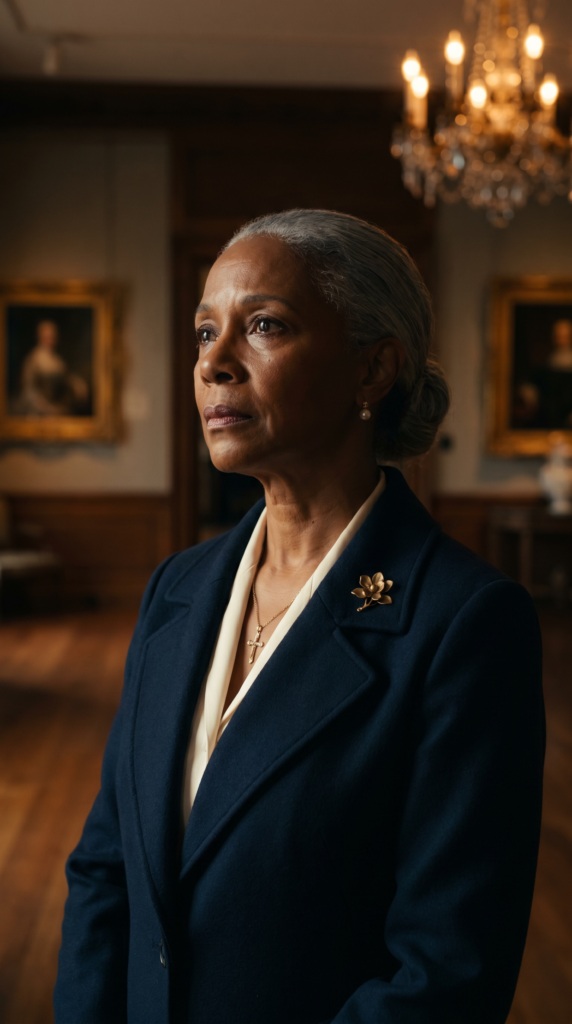
The Girl in the Portrait
At a private estate auction in Newport last Saturday, a 67-year-old Black woman walked past a $4.2 million Wyeth portrait — and stopped dead in her tracks. The painting recognized her before anyone else did.
At a private estate auction at the Hayworth Mansion in Newport, Rhode Island last Saturday evening, a 67-year-old African American woman in a navy blue coat walked into a $4.2 million private viewing without an invitation. She did not have a paddle. She was not on the guest list. She moved quietly through the crowd of tuxedoed collectors and elegantly dressed wives, past gilt-framed paintings worth more than houses, past a string quartet playing Schubert in the conservatory. She stopped in front of the auction’s centerpiece — a 1958 Andrew Wyeth oil portrait titled “Portrait of an Unknown Child.” She looked up at the painting for a long time. When the white auctioneer asked her, politely, to leave, she did not turn around. She said, quietly, “I am the child in the portrait.” Sixty-eight years of silence ended in that sentence.
Her name was Ruth Mae Williams.
She was sixty-seven years old. She was a retired second-grade public schoolteacher from Jackson, Mississippi. She had taught thirty-eight years at Lanier Elementary, the same school she had attended as a child. She had retired in 2022. She had two grown sons. She had four grandchildren. She lived alone in a small brick house on Bailey Avenue with a magnolia tree in the front yard and a cat named Olive who had been hers for fourteen years.
She had been to Newport, Rhode Island, exactly once before in her life. She had been six years old at the time. The year had been 1958.
Her Mother
Her mother’s name had been Beulah Williams. Beulah was a domestic worker, born in 1924 in Yazoo County, Mississippi, to sharecropping parents. She had come north in 1949, at the age of twenty-five, on the Illinois Central Railroad with seventeen dollars sewn into the hem of her dress and a letter of introduction from her cousin in Boston. She had worked, briefly, in Boston for a Brahmin family who paid her three dollars a week to clean a four-story townhouse on Beacon Hill. After eighteen months she had been laid off when the family’s grandmother died and the family no longer needed her.
In April of 1951, through a placement agency on Tremont Street, Beulah had been hired by a young Newport industrialist named Harrison Hayworth III. Harrison was twenty-eight years old at the time. He had inherited his father’s family textile manufacturing business in 1950. He had recently married a young Boston debutante named Elizabeth Cabot. They had bought a thirty-room mansion overlooking the Newport harbor. They needed a housekeeper.
Beulah moved to Newport in May of 1951. She lived in the small servants’ quarters on the third floor of the mansion. She earned eighteen dollars a week. She cleaned the mansion, served meals, mended clothing, and supervised the two Irish maids who had been there since the elder Hayworth’s day. She worked six days a week and was off on Sundays. She attended a small Black Baptist church in Providence on Sundays, taking the train down and back the same day. She saved most of what she earned.
In November of 1952, in Providence, she met a young Pullman porter named Howard Williams. He was thirty-one years old. He had been raised in Jackson, Mississippi. He was kind. He was steady. He worked the New York-to-Boston routes on the Pullman line. They were married in March of 1953 in the small Providence church. Howard kept his job. Beulah kept hers. They saw each other on weekends. They saved for a future.
Ruth Mae was born in October of 1952, eight months after her parents’ wedding — a date that mattered to no one but the families themselves, who never spoke of it. Beulah took six weeks of unpaid leave from the Hayworth household. She returned to work in December with the baby in tow. Mrs. Hayworth had agreed, somewhat reluctantly, that Beulah could bring the infant during the day. Elizabeth Hayworth had been unable to conceive, which she resented. She did not particularly want to see a Black baby in her marble entryway every morning. But she had also grown attached to Beulah in the previous two years. She had agreed.
Ruth Mae spent the first six years of her life in the Hayworth mansion.
Andy
Andrew Wyeth was thirty-five years old in the spring of 1958. He had recently completed Christina’s World, the painting that would define his career. He was famous in art circles. He was not yet famous to the broader public. He spent his summers in Cushing, Maine, and his winters in Chadds Ford, Pennsylvania. He occasionally took commissions for portraits when the price was right.
In April of 1958, Harrison Hayworth III commissioned Wyeth to paint a portrait of his wife Elizabeth. Wyeth came to Newport in May. He took up residence in the mansion’s guest cottage for six weeks. He set up an easel in the conservatory. He worked in the mornings. He painted Elizabeth Hayworth in a high-backed velvet chair, in a pale blue dress, with her hands folded in her lap.
He did not like the portrait. He told Hayworth so on the third week. Elizabeth Hayworth was a stiff sitter. She was self-conscious. She had no interior life that Wyeth could find in her face. He painted her well enough, but he was not finishing the portrait with the kind of urgency he gave his other work. He extended his stay by another month, hoping to find something.
In June of 1958, Wyeth was sitting in the conservatory at four in the afternoon, sketching idly, when six-year-old Ruth Mae Williams wandered in from the kitchen. She had a leather-bound book of nursery rhymes in her hand — a book her father Howard had given her for her sixth birthday in October. She did not see Wyeth at first. She climbed into the velvet chair where Mrs. Hayworth had been sitting that morning. She opened her book. She began to read aloud to herself, in the careful slow voice of a child still learning the shapes of words.
Wyeth watched her for ten minutes without speaking. Then he stood up. He went to find Beulah in the kitchen. He asked her, with the careful courtesy he reserved for the people he respected, if he might paint her daughter.
Beulah did not know what to say. She had cleaned for the Hayworths for seven years. She had never once been asked her opinion on anything by a guest of the family. Andy Wyeth was a guest. He was also, she suspected, an unusual man. She agreed, on the condition that Ruth Mae would not be required to sit still for long periods. The child was six years old. She was full of motion.
Wyeth painted Ruth Mae over the course of four afternoons in late June of 1958. He had her sit in the same velvet chair, in a yellow Sunday dress her mother had sewn for her, holding the same leather book. She did not have to be still. He let her read aloud. He let her fidget. He sketched her between her own movements. He worked quickly. He had found, in this child, the thing he had not been able to find in Mrs. Hayworth — a small dignified human being with an entire interior life visible on her face.
On the last afternoon — June twenty-eighth, 1958 — Wyeth finished the portrait. He stepped back. He looked at it for a long time. He turned to Beulah, who had been watching from the doorway with a small Polaroid camera she had borrowed from one of the Irish maids. He nodded at her. He said: “Take a picture. This is the only time my work has ever made me cry.”
Beulah took two photographs that afternoon. One was of Ruth Mae sitting in the chair, alone, with the finished painting visible on the easel behind her. The other was of Ruth Mae sitting in the chair with Wyeth himself standing beside her, his paintbrush still in his hand, smiling at the camera. Wyeth signed the photographs in pencil on the back of each: Ruthie and Andy. June 1958. Mama took this.
He gave one of the photographs to Beulah. He kept the other for himself. He put away his paints. He left Newport the following morning.
What Harrison Did
Harrison Hayworth III saw the portrait of Ruth Mae for the first time on the evening of June twenty-ninth, 1958. Wyeth had left it in the conservatory, leaning against the wall, drying. Harrison came home from a business trip that night. He walked into the conservatory. He stood in front of the painting for ten minutes without moving.
He did not call his wife. He did not call Beulah. He went to bed.
The next morning, Harrison contacted Wyeth at his Chadds Ford studio. He offered to buy the portrait of Ruth Mae outright. He told Wyeth he wanted to keep the painting in the family. Wyeth named a price. It was higher than the price he had named for Mrs. Hayworth’s portrait. Harrison agreed without negotiating.
In July of 1958, the portrait was crated and shipped from Pennsylvania back to Newport. Harrison hung it in his private library on the third floor — a room Mrs. Hayworth rarely entered and that Beulah cleaned only on Saturdays when Harrison was at his club. He had a placard made in 1959 that read: Portrait of an Unknown Child — Andrew Wyeth — 1958. He never told Wyeth that he had retitled the work. Wyeth did not learn of it until 1989, when the painting was first publicly exhibited as part of a touring Wyeth retrospective. By then, the title was established in the catalogue raisonné. Wyeth, by then seventy-two and tired, did not protest.
Harrison Hayworth III told Beulah, in July of 1958, that the painting was his now. He told her she was not to mention it to her daughter. He told her that if she did, she would be dismissed without references. He told her that he believed it was best, for everyone, if Ruth Mae never knew the portrait existed. He told her the child’s place in the world would be made harder by knowing she had been painted by a famous man and then quietly hidden away in a private library.
Beulah did not understand at first. She tried to argue. Harrison silenced her with the kind of look that, in 1958, ended arguments between Black domestics and their white employers. She apologized. She agreed.
She kept the secret for the rest of her life.
Mississippi
In October of 1958, four months after the portrait was completed, Beulah’s mother died in Mississippi. Beulah went home for the funeral. While she was there, her father — who was sixty-eight years old and frail — asked her if she would consider staying. He was alone now. He could not work the land. He needed his daughter.
Beulah talked to Howard. Howard had been considering leaving the Pullman line for years. The work was hard. He was rarely home. They had been thinking, quietly, about what life might look like if they had their own small house in the South, near family, with land. They talked for a week. They decided.
Beulah gave the Hayworths notice on October the twenty-second, 1958. Harrison was displeased. He had not anticipated losing her. He offered her a raise. She refused. He offered to relocate her father to Newport. She refused. He understood, finally, that she was going.
She left Newport on November the fourth, 1958. She took her daughter, two suitcases, and the small black-and-white photograph Andy Wyeth had given her on the last afternoon. She did not see the portrait again. She did not see Newport again.
Beulah and Howard Williams moved into a small clapboard house on Bailey Avenue in Jackson, Mississippi, in late November of 1958. Howard found work as a custodian at the Veterans Administration Hospital. Beulah took in laundry and cleaned houses two days a week. They raised Ruth Mae quietly. They sent her to Lanier Elementary School. They paid their taxes. They went to Greater Mount Calvary Baptist Church on Sundays. They taught their daughter to read at an extraordinary level for her age, because she had begun reading at four, and they did not want her gift to be wasted.
Beulah Williams died of complications from breast cancer on November the eleventh, 1979. She was fifty-five years old. Ruth Mae was twenty-seven. Beulah told her daughter about the portrait three days before she died.
What Her Mother Told Her
She told her the story of Andy. The conservatory. The yellow dress. The leather book. The four afternoons of painting. The photograph she had taken. She told her about Harrison Hayworth and the agreement he had forced her to make. She told her she had kept the secret for twenty-one years because she had been afraid of him — even after they had left Newport, even after she had moved to Mississippi, she had remained afraid that he would find a way to harm her family if she spoke.
“He could have hurt your daddy at the VA,” she told her daughter. “He had connections everywhere. He was a powerful man. I did what I had to do to protect us.”
She gave Ruth Mae the small black-and-white photograph from June 1958. She told her where the portrait had been hung. She told her she did not know whether it still existed.
“I would have liked to have seen it once,” Beulah said. Her voice was very weak. “I painted you in my own head for twenty-one years, baby. I would have liked to have seen what Andy saw.”
Ruth Mae held her mother’s hand. She did not cry. She had never cried easily. She told her mother she would see the portrait one day. She would see it for her.
Beulah Williams died at 4:17 in the morning on November the eleventh, 1979.
Ruth Mae kept the photograph in a small leather wallet from that day forward. She carried it everywhere. She did not show it to anyone for forty-seven years. She did not tell her sons. She did not tell her husband Howard Junior, who died in 2014. She did not tell her grandchildren. She told no one. She had decided, when her mother died, that the secret would either come into the light on its own — or it would die with her.
How She Found It
In April of 2026, Ruth Mae was sitting in her living room in Jackson watching the evening news on a public television channel. The local affiliate ran a segment on a major estate auction scheduled for the following month in Newport, Rhode Island. The Hayworth Mansion was being sold. The estate of Harrison Hayworth III — who had died in 2019 — was being liquidated. His granddaughter Catherine Hayworth, now 48 years old, had inherited the mansion and was selling most of its contents.
The reporter on the news segment, standing in the mansion’s gallery, pointed to a painting above a marble fireplace.
“The centerpiece of the auction,” he said, “is this newly authenticated Wyeth portrait, titled Portrait of an Unknown Child, expected to fetch between three and five million dollars.”
The camera lingered on the painting for ten seconds.
Ruth Mae set down her cup of tea. She did not move for a long time.
She had not seen her own face — her six-year-old face — in sixty-eight years.
She got up. She went into the bedroom. She opened the top drawer of her dresser. She took out the small leather wallet. She removed the small black-and-white photograph from 1958. She compared the photograph to her memory of the news segment.
Yellow dress. Velvet chair. Leather book. Same hands. Same eyes. Same girl.
She bought a plane ticket to Providence the next morning.
The Auction
She arrived at the Hayworth Mansion at six fifteen in the evening on Saturday, May the twenty-third, 2026. The private viewing had begun at six. The actual auction was scheduled for seven thirty. She wore her navy blue wool coat, which had belonged to her late husband Howard’s mother. She wore small pearl earrings. She carried a small leather handbag with the photograph inside.
She did not have an invitation. She walked up the marble steps. The doorman, a young man in a tuxedo, asked for her name. She said, quietly, “Williams.” He looked at the list. He did not find her name. He hesitated. She did not move. She did not explain. She did not look away. He looked at her for a long moment. He let her in. He could not have said, afterward, why he had done it.
She walked through the foyer, past the marble columns, past a string quartet playing Schubert in the conservatory. She moved through the gallery slowly. She walked past oil paintings worth more than the house her parents had bought on Bailey Avenue in 1958. She did not look at them. She walked toward the back of the gallery.
She stopped in front of the painting above the marble fireplace.
She looked at it for a long time.
A young woman in a black dress with a clipboard, an auction house intern named Rachel, approached her gently. “Ma’am, may I see your invitation?”
Ruth Mae did not turn from the painting. She did not raise her voice. She said, “I am the child in the portrait.”
Rachel froze. She did not know what to say. From across the gallery, the senior auctioneer Jonathan Blake saw the moment and walked over.
Jonathan was fifty-two years old. He had handled estate auctions for thirty years. He had developed the polished smile of a man who knew how to gently remove confused elderly visitors from private events. He approached Ruth Mae with the smile already in place.
“I’m so sorry, ma’am,” he said. “This is a private viewing. The portrait is titled —”
“Portrait of an Unknown Child,” Ruth Mae said quietly, still not turning. “Andrew Wyeth. Nineteen fifty-eight. Estate of Harrison Hayworth the Third.”
She turned. She looked Jonathan in the eye.
“My name is Ruth Mae Williams. My mother was Beulah Williams. She worked in this house from nineteen fifty-one to nineteen fifty-eight. Andy Wyeth painted me in the conservatory in June of nineteen fifty-eight. Harrison Hayworth bought the painting from Andy in July of the same year. He told my mother she was never to mention it to me. She did not. She died in nineteen seventy-nine without ever seeing it again.”
Jonathan’s smile faded.
He said, carefully: “Mrs. Williams. That is an extraordinary claim. Without proof of provenance —”
Ruth Mae reached into the inner pocket of her navy coat. She removed her small leather wallet. She opened it. She removed the faded black-and-white photograph from June 1958. She held it up between two fingers.
She handed it to Jonathan.
He took it slowly. His hand was trembling. He looked at the photograph. He looked up at the oil portrait on the wall. He looked at the photograph again. The same girl. The same chair. The same yellow dress. The same leather book.
In the photograph, standing beside the chair, was Andrew Wyeth himself, paintbrush in hand, smiling.
Jonathan turned the photograph over. On the back, in pencil, in handwriting Wyeth experts had spent forty years studying: Ruthie and Andy. June 1958. Mama took this.
Jonathan did not speak. He could not.
Catherine
From across the gallery, a 48-year-old white woman in a fitted black dress had been watching. She was Catherine Hayworth, the granddaughter of Harrison Hayworth III. She owned the estate. She had been about to sell the painting in less than two hours for an estimated four point two million dollars.
She walked over slowly.
She stopped two feet from Ruth Mae. She looked at her for a long moment. She had her grandfather’s grey eyes. She did not have his polished cruelty.
She said, quietly: “Mrs. Williams. My grandfather died in twenty-nineteen. Before he died, he left a sealed envelope with our family attorney. He left specific instructions. The envelope was to be opened only in the presence of the woman who could prove she was the child in the painting. He told us, very clearly, that someone might come. He told us to wait for her. He said her name might be Williams.”
Ruth Mae did not move.
Catherine continued. “I have been the executor of his estate since twenty-nineteen. I have been waiting seven years for this moment. I did not know if you existed. I did not know if you would come. When I scheduled this auction in March, I included the painting against the advice of our attorney, who reminded me of the sealed envelope. I believed the painting needed to be in public view for you to find it. I did not know how else to bring you here.”
She gestured to a man in a charcoal suit standing at the back of the gallery — the Hayworth family attorney — who came forward holding a thick cream-colored envelope with a deep burgundy wax seal stamped with the Hayworth family crest.
Catherine took the envelope. She held it out to Ruth Mae.
“He has been waiting sixty-eight years for you to come find this,” she said softly.
The gallery was completely silent. Even the string quartet in the next room had stopped playing. The wealthy collectors in their tuxedos and gowns had set down their champagne glasses. The European bidders stood frozen.
Ruth Mae’s hands were trembling. She took the envelope.
She did not open it. She held it.
She looked at Catherine.
“I am going to ask you,” she said quietly, “to send everyone home. The auction will not happen tonight. The painting is not for sale.”
Catherine nodded. She did not argue. She turned to the room. She raised her hand. She said, in the voice she had inherited from her grandfather: “Thank you all for coming. The auction is suspended. There will be no bidding tonight. You will all be contacted by our office in the coming days regarding any other items of interest.”
The collectors did not protest. They did not understand what was happening, but they understood that they were no longer the most important people in the room. They began, slowly, to file out.
Within fifteen minutes, the gallery was empty.
Only three people remained: Catherine Hayworth, Jonathan Blake, and Ruth Mae Williams.
Catherine asked, quietly: “Mrs. Williams. Would you like to open the envelope now?”
Ruth Mae nodded.
She broke the wax seal.
The Letter
Inside the envelope were four documents.
The first was a handwritten letter, dated April twelfth, 2019 — six weeks before Harrison Hayworth III died at the age of ninety-six.
The letter read:
To the child in the portrait —
If you are reading this letter, it means you have come back, or your mother’s daughter has come back, or her daughter has come back. It means that someone has finally seen the painting and known what it was, and brought the proof, and asked to be acknowledged. I have been waiting for this letter to be opened for sixty-one years.
I am writing this letter at the age of ninety-six. I do not have long left. I have spent the last forty years of my life trying to find the courage to do what I am doing now. I do not have the courage to do it directly. I am doing it through my granddaughter Catherine, who is a better person than I have ever been, and who I trust to receive you correctly when you come.
I bought the portrait of you from Andy Wyeth in July of nineteen fifty-eight because I had fallen in love with you the moment I saw it. I do not mean that in a way that should disturb you, child. I mean that I had not, until that moment, understood that a small Black girl reading aloud in my conservatory was as fully a person as any of us. I do not say this to my credit. I say it as a confession. I had lived for thirty-five years and I had never once truly seen a Black person as my equal in interior life. Andy’s painting forced me to. I bought the painting because I needed to keep looking at it. I needed to keep being forced.
I told your mother that you could never see it. I told her this because I was afraid. I was afraid that if you saw the painting, you would understand that I had bought you. That I had taken what was not mine to take. That I had hidden a famous portrait of a Black child in my private library so that no one would know I had it. I was right to be afraid. I had done all of those things. Your mother knew. She kept silent because I threatened her. I am sorry for that, child. I have been sorry for sixty-one years.
After your mother left in nineteen fifty-eight, I tried to find her several times. I had her address in Mississippi. I never wrote. I never visited. I was a coward. In nineteen seventy-nine, when I learned through my own private inquiries that she had died, I tried to find her daughter. I learned your name. I learned where you lived. I considered writing. I did not. I did not know what to say. I did not believe I had earned the right to say anything.
I have done one thing, child. I want you to know about it.
In nineteen eighty, after your mother died, I established a trust. The trust was funded by the appreciated value of two stocks I sold in late nineteen seventy-nine. The trust was set up to pay for the post-secondary education of Black children from Mississippi. It has paid for the college and graduate education of four hundred and forty-seven children since nineteen eighty-one. It currently has a balance of nineteen million dollars. It will continue paying out for at least the next fifty years.
The trust is named the Beulah Williams Memorial Trust. It does not have her last name correctly attached. I did not want to risk you finding it before you found me. I wanted you to find me first.
I am also leaving you the portrait. It is yours. It has been yours since nineteen fifty-eight. I should not have kept it. The painting will be in your possession the moment you open this envelope. Catherine has been instructed to give it to you free of any obligation. Take it home. Or sell it. Or burn it. It is yours.
I am also leaving you the mansion. It is in your name, in trust, conditional on your acceptance, effective the day you open this envelope. The mansion is worth approximately twenty-eight million dollars. The grounds are seven acres of harbor-front property. I am not asking you to live in it. I am asking you to do whatever you would like with it. Catherine will help you transition ownership if you choose to accept it. She does not need this house. She has her own life. She has been generously provided for.
I do not deserve forgiveness. I am not asking for it. I am only asking that what was hidden be unhidden. I am asking that your mother’s daughter know that her mother was loved by a man who could not say so, in a house where she was paid eighteen dollars a week, while she raised a child whose face stopped Andy Wyeth in his tracks and made him cry.
Your mother was a great woman, child. I knew it. I never told her. I should have.
I am sorry. I will be sorry until the day I die — which will be soon now.
— Harrison Hayworth III
April 12, 2019
Ruth Mae read the letter twice. She sat down on a small upholstered bench in front of the marble fireplace. Catherine and Jonathan stood quietly nearby. They did not speak. They waited.
The second document in the envelope was a copy of the trust agreement establishing the Beulah Williams Memorial Trust, dated December the first, 1980.
The third was a deed transferring ownership of the Hayworth Mansion at 17 Bellevue Avenue, Newport, Rhode Island, to Ruth Mae Williams, effective May the twenty-third, 2026 — the date of the auction.
The fourth was a small folded note, also in Harrison’s handwriting, dated 1980. It said only:
Beulah — I am sorry. You were right. I was wrong. The girl will know one day. — H.
It was the apology he had owed her mother for twenty-two years. He had written it in 1980, after she had died. He had never had anyone to give it to.
Now he did.
What She Did
Ruth Mae Williams accepted the painting. She did not sell it. She did not burn it. She had it crated and shipped to the Mississippi Museum of Art in Jackson, where it was donated permanently, on the condition that the placard be changed.
The painting is now titled: Ruthie Williams, Aged Six — Painted by Andrew Wyeth — Jackson, Mississippi, June 1958. Photograph and provenance courtesy of Beulah Williams, the artist’s friend.
It hangs in the museum’s main gallery. Schoolchildren from Lanier Elementary visit it every spring on a field trip arranged by Ruth Mae herself. The museum does not charge admission on those days.
She accepted the trust. The Beulah Williams Memorial Trust now operates under its correct full name — The Beulah Williams Memorial Trust for the Education of Black Children of Mississippi. Ruth Mae sits on the board. The first four scholarship recipients of 2026 each received a personal letter from her, handwritten, telling them about her mother.
She did not accept the mansion. She signed a document transferring ownership to a new foundation she established in her mother’s name. The Hayworth Mansion is now The Beulah Williams House — a residency program for Black writers, artists, and scholars from the South, offering twelve-week stays in Newport with a stipend. The first cohort of six fellows arrived in September of 2026. Ruth Mae visited them on the first day. She told them, in the same conservatory where Andy Wyeth had once painted her, the story of how the house had come to be theirs.
She kept one thing from the estate for herself — the small velvet chair from the portrait. It is in her living room on Bailey Avenue in Jackson now. Olive the cat sleeps in it most afternoons.
She is in regular correspondence with Catherine Hayworth, who flew down to Mississippi in November of 2026 to visit her. They had lunch at a small soul food restaurant in Jackson. Ruth Mae paid. They have become, in the careful slow way of two women who did not choose to be connected but have been connected anyway, friends.
The photograph from June 1958 is back in Ruth Mae’s leather wallet.
She still carries it everywhere.
She says, when people ask her about that night in Newport, only this:
“My mama lived eighteen-dollar weeks in that house for seven years. She didn’t get to see her daughter on a wall. I got to. I went and stood under it. I told them my name. The painting knew who I was before any of them did.”
She pauses.
“Mama’s name is on the wall now, in two cities. I think she would have liked that. I think she would have said it was about time.”
Continue Reading
More stories you’ll love
The Name She Never Used
She buried it for sixty-two years. Then a ten-year-old girl handed her an envelope at brunch…
The Woman at Pew Seven
Every pew at the funeral was full — except for the one in the back, where a woman nobody recognized had been waiting fifty-five years to say goodbye…
The Coffee Lady
For 30 years they laughed at her cheap shoes. They never noticed the notebook in her purse…