
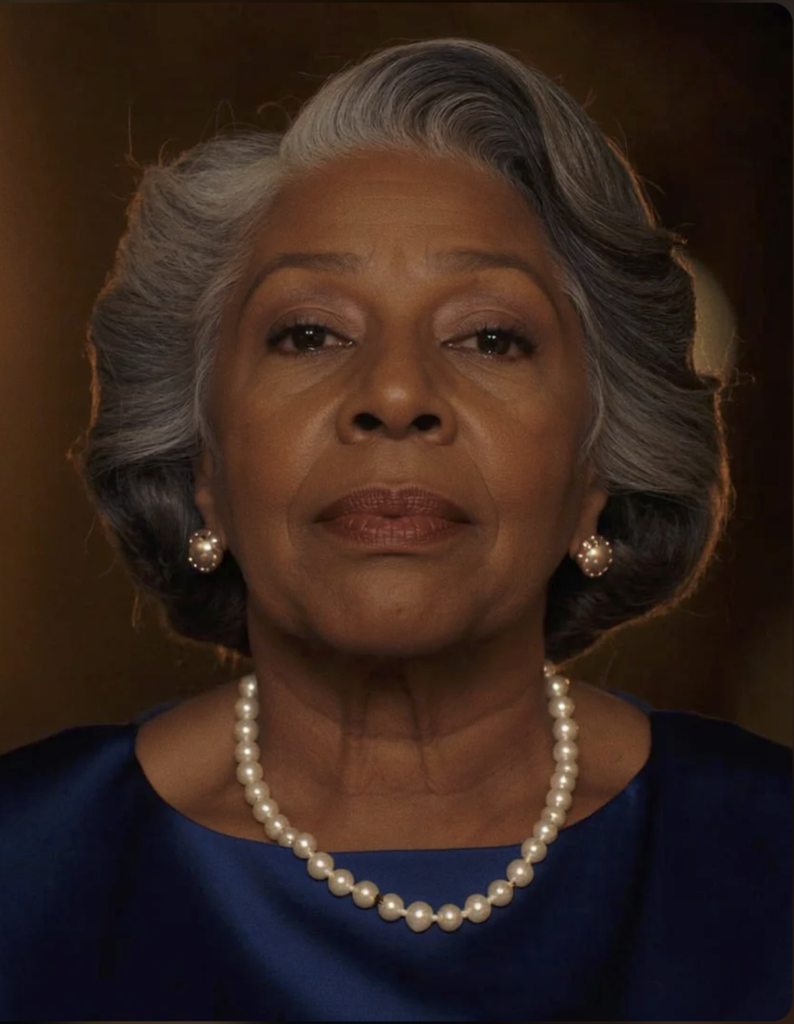
The Woman at Table Nine
At a $400-a-plate charity gala at the Plaza Hotel last Saturday night, a 68-year-old Black woman in a navy silk dress sat alone at the back table for two hours. Then her name was called from the podium — and the room understood, all at once, who she actually was.
At a $400-a-plate charity gala at the Plaza Hotel in Manhattan last Saturday evening — May the twenty-third, 2026 — a 68-year-old African American woman in a navy silk dress sat alone at Table Nine for two hours and seventeen minutes. Table Nine was the back table. It was the overflow table — the table reserved for last-minute RSVPs and unimportant guests. The wealthy white donors at the front tables glanced at her occasionally with curiosity. Some assumed she was catering staff. The waiter passed her three times without offering a refill. The blonde woman at the adjacent Table Seven looked away when their eyes met. Nobody approached her. Nobody spoke to her. Nobody asked her name. She sat with her hands folded in her lap, an untouched glass of red wine beside her right hand, and she observed the room with the patient knowing of a woman who had been ignored in better rooms than this one. Then the chairwoman of the gala took the podium and read a name from a small white index card. And the entire ballroom understood, in the span of one quiet sentence, that they had spent the entire evening pretending not to see the most important person in the room.
Her name was Mrs. Eunice Mae Carter.
She was sixty-eight years old. She lived alone in a brownstone on West 138th Street in Harlem — the same brownstone she had purchased in cash in 1991 for two hundred and forty-six thousand dollars. She had a cat named Thelonious. She drank her coffee black. She read the Sunday New York Times in print every Sunday morning at a small kitchen table by the window. She had not given a single newspaper interview in forty-one years.
She was, at the time of the Plaza gala, the personal trustee of the Carter Educational Trust — a private foundation she had quietly funded since 1985 with the personal profits of a small but extraordinary career on Wall Street. The trust had distributed, in its forty-one years of operation, four hundred and seventeen million dollars to inner-city educational programs in New York City, Atlanta, Chicago, New Orleans, and Detroit. It had funded the college educations of more than nine thousand Black and Latino children from low-income families. It had built two charter schools in Harlem, three in the South Bronx, and one in East New York. It had paid the salaries of seventy-two public school teachers in underfunded neighborhoods for the last twelve years.
She had never given a speech about it. She had refused every award. She had refused every interview. She had refused every photograph. The trust’s annual report bore no photograph of her. Her name appeared on no plaque. The two charter schools in Harlem bore the names of two long-dead Black educators she had admired as a child. The teachers she paid did not know who paid them. The students she sent to college did not know who had funded their tuition.
She had wanted it that way for forty-one years.
The Gardener’s Daughter
Eunice had been born in 1958 in a small wood-frame house on a back lane behind the Whitfield estate in Newport, Rhode Island. Her father, Cornelius Carter, was the gardener. He had served the Whitfield family for thirty-one years. Her mother, Lucille Carter, was the laundress. She had served them for twenty-six. They had raised three children in that small house behind the estate. Eunice was the youngest. Her two older brothers had gone into the Army and the Post Office. They were good steady men. They were not their sister.
Eunice had been, from the age of six, an extraordinary student. She had read at adult level by the time she was eight. She had taught herself basic algebra from a discarded textbook her father had found in the Whitfield trash. By the age of twelve she had read every book in the small Newport public library that was accessible to Black children — which, in 1970, was not all of them.
In 1972, at the age of fourteen, she had applied for the inaugural year of the Whitfield Family Foundation Scholarship — a program established by the Whitfield matriarch, Constance Whitfield, ostensibly to fund the post-secondary education of “promising Negro children of New England working families.” The application had been promoted to her family by the Whitfield household manager. Eunice had filled it out by hand at her kitchen table over three nights. She had written a personal essay on the meaning of literacy in the life of a child. She had attached transcripts showing perfect grades. She had attached a letter of recommendation from her ninth-grade English teacher — a young white woman from Providence who had cried when Eunice had first read her essay aloud.
Eunice had been rejected. The rejection letter, which had been mailed to her family’s address on Whitfield estate property, had been signed by Constance Whitfield herself. It had cited “insufficient demonstrated potential.”
Eunice had applied again the following year. She had been rejected again. The second rejection letter had cited “concerns about cultural fit with our scholar community.”
She had applied a third time in 1975, at age seventeen, with even better grades and a national essay prize to her name. She had been rejected a third time. The third rejection letter had cited “limited available funds for this cycle.”
All three rejection letters had been preserved by Cornelius Carter in a small tin box in the kitchen of the small wood-frame house behind the estate. He had told his daughter, on the night of the third rejection, that she should remember the letters but not let them harden her. “Hard women break harder, Niecey,” he had told her, in his slow Charleston accent. “You are going to be soft. You are going to be soft for the rest of your life. The world is going to give you a thousand reasons to harden, baby, and you are going to refuse every one of them. You hear me?”
She had heard him. She had remembered. She had not hardened.
She had also kept the three rejection letters.
She Went Anyway
Eunice graduated from Rogers High School in Newport in 1976 as valedictorian. She had earned a full academic scholarship — not from the Whitfield Foundation, but from a small Quaker college in Pennsylvania called Swarthmore — based on her national essay prize and her grades. She had majored in economics. She had graduated summa cum laude in 1980.
In the autumn of 1980, at the age of twenty-two, she had been hired into the analyst program at Goldman Sachs in New York City. She was one of three Black women in the program that year. The other two had quit within eighteen months. Eunice had not. She had been promoted to associate in 1982. To vice president in 1985. To managing director in 1991. To partner in 1996. She had retired in 2017, at the age of fifty-nine, with a personal net worth that financial press had estimated, conservatively, at three hundred and twenty million dollars.
In 1985, the same year she had been promoted to vice president, she had established the Carter Educational Trust.
She had named no one to its board but herself. She had given it no public address. She had funded it, that first year, with one hundred thousand dollars of her own bonus money — which had been, at the time, half of what she had made for the entire year. The next year she had given the trust two hundred thousand dollars. The year after that, four hundred thousand. By 1996, when she made partner, she was giving the trust four million dollars annually. By 2017, when she retired, the trust held two hundred and ten million dollars in endowed assets.
She had paid for the college educations of nine thousand and forty-one Black and Latino children from low-income families. Most of them had never heard her name.
She had also, in 1985, written a single check for fifteen thousand dollars to her father Cornelius. Cornelius had retired that year, at the age of sixty-three, after thirty-one years as the Whitfield estate gardener. The check had paid off the mortgage on the small house in Newport where he and Lucille had raised their children. Cornelius had cried when she had handed it to him. He had not cried at any other moment in his daughter’s adult life, before or after.
He had died in 1997 at the age of seventy-five. Lucille had died in 2003. Eunice had buried them both in the small Black cemetery on the edge of Newport. She had not returned to Newport since.
The Invitation
In March of 2026, Eunice had received, in the regular morning mail at her Harlem brownstone, a heavy cream-colored envelope with a deep burgundy wax seal. It had been hand-addressed in elegant calligraphy. The return address was the Whitfield Family Foundation, 47 East 78th Street, New York, New York.
Inside was an invitation to the foundation’s annual spring gala at the Plaza Hotel — a $400-a-plate charity dinner whose stated purpose was to raise funds for “educational programs serving disadvantaged urban youth.” The host of the evening was Margaret Whitfield, age fifty-five, the granddaughter of the late Constance Whitfield. Margaret had become foundation chairwoman in 2020.
The invitation included a personalized note, in Margaret’s own handwriting:
Dear Mrs. Carter — Our foundation’s records indicate that your educational trust has, over the past four decades, served many of the same neighborhoods our scholarships have aimed to support. I would be honored if you would attend our spring gala as my personal guest. I believe there is much our two foundations could learn from one another. — Warmly, Margaret Whitfield.
Eunice had set the invitation on her kitchen table. She had drunk her coffee. She had read the morning Times. She had thought about it.
Margaret Whitfield did not know who she was. The note made that clear. The “records indicate” phrasing was a polite fiction — the Whitfield Foundation almost certainly did not even know that the Carter Educational Trust existed. Margaret had been told by some staff member to invite the chairs of every educational foundation in the New York metro area as a goodwill gesture. Eunice’s name had landed on the list because the Carter Trust filed required disclosures with the state attorney general. That was all.
Eunice had thought about the three rejection letters in her father’s tin box. She had thought about her father telling her, on a porch in 1975, that she was going to be soft for the rest of her life.
She had RSVP’d yes.
She had also made one quiet phone call to her personal attorney, Bernard Holloway of Holloway & Singh, on the morning of May the twentieth, three days before the gala. She had given him one specific instruction. He had agreed to it without question. He had drafted what she had asked for on a single white index card, sealed it in a small cream envelope, and couriered it to her brownstone by Friday afternoon.
She had placed the envelope in her small clutch purse on Saturday evening, at six-fifteen, before leaving for the Plaza.
Table Nine
She arrived at the Plaza at seven thirty-eight in the evening. She wore the navy silk dress she had bought for her own retirement party at Goldman Sachs in 2017 — a dress she had worn only twice in the nine years since. She wore her mother Lucille’s pearls. She wore small classic pearl stud earrings she had bought for herself at Tiffany’s in 1991, on the day she had purchased her Harlem brownstone in cash. She carried a small black clutch.
She gave her name to the young white woman at the seating desk. The young woman scanned her clipboard. She did not look up. She said, distractedly: “Mrs. Carter… Mrs. Carter… ah. Yes. Table Nine. That’s the back of the ballroom, on the left side. The waiter will show you.”
Eunice nodded. She walked into the ballroom.
The ballroom was, that evening, lit with the warm amber light of seven enormous crystal chandeliers. Two hundred guests were dining at twenty-three gilded round tables. A string quartet was playing, very softly, in the corner of the room. A small podium with a microphone had been set up at the front of the room. The walls were hung with massive oil portraits of Whitfield ancestors going back four generations. One of those portraits, Eunice had noted as she walked past, was of Constance Whitfield herself — the woman who had signed her three rejection letters in 1972, 1973, and 1975.
Eunice did not stop to look at the portrait. She walked to the back of the room. She sat at Table Nine. She set her clutch on the table beside her. She folded her hands in her lap.
She was alone at the table. The four other place settings at Table Nine — set with white linen napkins and gilt-edged plates — were empty. They would remain empty for the entire evening. The other Table Nine guests had not come.
The first course arrived. A young white waiter, no older than twenty-two, placed a small porcelain bowl of butternut squash soup in front of her. He did not look at her face. He moved on. Eunice did not touch the soup. She had eaten a sandwich at her kitchen table before leaving Harlem.
The second course arrived. The waiter set down a plate of seared duck with cherry reduction. He did not refill her wine glass. He moved on. Eunice did not touch the duck either.
At Table Seven, three feet to her right, a blonde woman in a silver gown was telling a long story about her summer in Provence. She glanced at Eunice once. She turned back to her companions. Her eyes did not return.
At Table Six, two men in tuxedos were laughing about a hedge fund colleague’s recent divorce. They did not glance at Eunice at all.
At Table Three, near the front, Margaret Whitfield in her silver gown was holding court with a dozen of the foundation’s biggest donors. She had not yet noticed that the chair of the Carter Educational Trust was sitting at the back of her ballroom in a navy silk dress.
Eunice waited.
She had waited longer than this. She had waited fifty-one years.
The Speech
At nine forty-seven in the evening, after the third course and the dessert and the cordials, Margaret Whitfield stepped to the podium at the front of the ballroom. She tapped the microphone. The string quartet stopped playing. The room, two hundred guests strong, hushed.
Margaret unfolded a small white card.
“Ladies and gentlemen,” she began, in her refined Upper East Side accent. “Tonight is the night we announce the recipient of the Whitfield Family Foundation Annual Grant — a five-million-dollar award that recognizes one woman each year whose lifelong dedication to educational equity for disadvantaged urban youth has, in our judgment, gone unrecognized and uncelebrated for too long.”
A polite ripple of applause. Margaret raised her hand for silence.
“This year’s recipient,” she continued, “is a woman who has spent forty years quietly funding educational programs for inner-city children in New York, Atlanta, Chicago, New Orleans, and Detroit. She has paid for the college educations of more than nine thousand Black and Latino children from low-income families. She has built five charter schools. She has funded the salaries of seventy-two public school teachers in underfunded neighborhoods. She has done all of this anonymously. She has refused every award. She has refused every interview. She has refused every photograph. We have only learned of her work through an exhaustive investigation by our foundation’s research staff over the past eighteen months — and through the cooperation of a New York state attorney general’s office that confirmed the trust’s filings under condition that her name would not be made public until tonight.”
A wave of murmurs passed through the room. Heads turned. Donors set down their wine glasses. The blonde woman at Table Seven leaned forward in her chair.
“Tonight,” Margaret continued, her voice softer now, almost reverent, “she has finally agreed to be recognized. She is here in this room with us. She is the chair of the Carter Educational Trust. Ladies and gentlemen — Mrs. Eunice Mae Carter — would you please stand.”
The room turned.
For a long moment, nobody knew where to look. The donors at the front tables scanned the front of the ballroom, then the middle, then the sides. They did not find her. Their eyes traveled, finally, to the back of the room.
Eunice slowly set down her wine glass — the wine glass that had remained untouched for two hours and seventeen minutes. She placed her hands on the white linen tablecloth. She rose. She rose with the slow grace of a woman who had been waiting for this moment with the patience of fifty-one years.
Two hundred wealthy white faces turned to face her.
A collective intake of breath passed through the room. The man at Table Two whispered something to his wife. The blonde woman at Table Seven put her hand over her mouth. The young waiter who had passed Eunice three times without offering a refill froze mid-step, his pitcher of ice water suspended in the air. At Table Three, near the front, Margaret Whitfield’s hand went slowly to her own throat. Her face had gone pale.
Eunice walked.
She walked through the ballroom with the steady unhurried pace of a woman who had been walking through rooms like this one for forty-six years. The crowd parted instinctively. A man at Table Five began, uncertainly, to applaud. Others joined him. The applause built — confused, dawning, ashamed. By the time Eunice had reached the middle of the room, two hundred wealthy donors were standing at their tables applauding a woman they had ignored for the entire evening.
Eunice did not smile. She did not nod. She did not acknowledge the applause. She walked the length of the ballroom in silence. She arrived at the podium. Margaret stepped aside, beaming through tears.
Eunice did not touch the microphone.
She opened her small black clutch. She removed the cream envelope. She broke the seal. She removed a single white index card. She placed the card gently on the lectern in front of Margaret. She looked at Margaret for a long moment.
Then she leaned slightly toward the microphone — close enough to be heard only by the front tables, not by the room.
She said, quietly: “Read this when I’m gone. I’m going home now.”
She turned. She walked back through the silent room toward the ballroom doors. The applause had stopped. No one breathed. Her navy silk dress moved softly with each step. Her mother’s pearls caught one last flash of amber chandelier light at her throat. She did not look back. She reached the doors. The doorman, a young Black man in a red uniform, opened the double doors for her with a small bow. She inclined her head to him. She walked through. The doors closed behind her with a soft heavy thud.
The Card
Margaret Whitfield stood at the podium for several seconds in stunned silence. The room remained perfectly still. Two hundred guests were standing at their tables, waiting.
Margaret picked up the white index card with trembling fingers. She looked at it. She looked up at the room. She looked back down at the card. She did not know what to do.
She read it aloud. Her voice cracked on the first sentence.
“The five million dollars is not a gift. It is a repayment. In nineteen seventy-two, nineteen seventy-three, and nineteen seventy-five, my application to the Whitfield Family Foundation Scholarship was rejected three times. The rejection letters cited insufficient demonstrated potential, concerns about cultural fit, and limited available funds. The letters were signed by your grandmother Constance Whitfield. I have kept all three letters for fifty-one years. I went to Swarthmore on a Quaker scholarship. I went to Goldman Sachs. I built what your grandmother told me, three times, that I should not be allowed to build. I have paid for the college educations of nine thousand and forty-one Black and Latino children since nineteen eighty-five. None of those children carry my name. None of them carry your grandmother’s name either. I am here tonight because your foundation invited me. Your records indicated that we served the same communities. Your records did not indicate who I was. I sat at Table Nine for two hours and seventeen minutes. Not one of your guests spoke to me. Your waiter passed me three times without refilling my glass. The woman at Table Seven looked away when our eyes met. Your foundation, Margaret, has not changed since nineteen seventy-five. The five million dollars is your foundation’s grant returned to you, in full, multiplied by the rate I would have charged my own client for forty years of compounded patience. It will be paid by the Carter Trust into a new scholarship fund administered jointly by Swarthmore College and Spelman College. The fund will be named the Constance Whitfield Memorial Scholarship for Black Daughters of Domestic Servants. It will fund the educations of one hundred Black girls per year for the next fifty years. Your grandmother’s name will be on every scholarship letter. The girls will understand who she was. The repayment ends tonight. We are even. — Eunice Mae Carter, May 23, 2026.”
Margaret finished reading. She set the card down. She did not look at the room. She walked to the side of the stage. She sat down on a small chair. She covered her face with her hands. She did not move for several minutes.
The room was still standing. The applause did not resume. Slowly, one table at a time, people began to sit down. The string quartet did not begin playing again. The waiters did not bring the next round of cordials.
The gala ended early. The guests filed out of the Plaza in near silence. Several of them, on the way out, asked the doorman if Mrs. Carter had left. The doorman said yes. He said she had walked to the corner of Fifth Avenue and Central Park South. She had not called a car. She had not hailed a cab. She had walked.
She had walked the seventy blocks back to her brownstone in Harlem. It had taken her two hours and fourteen minutes. She had arrived home at twelve forty-seven in the morning. She had let herself in. She had fed Thelonious. She had taken off her mother’s pearls. She had hung the navy silk dress in the closet. She had gone to bed.
The Aftermath
The Whitfield Family Foundation issued a public statement on Monday morning. The statement, written by Margaret personally, acknowledged the foundation’s “deep failures in earlier eras” and confirmed that the five-million-dollar grant would be transferred directly to the Constance Whitfield Memorial Scholarship for Black Daughters of Domestic Servants, exactly as Mrs. Carter had specified.
The first cohort of one hundred scholarship recipients will be selected in the spring of 2027. The applications will be evaluated jointly by Swarthmore and Spelman. Eunice Carter will not be on the selection committee. She has asked, instead, to be sent a list of the recipients each year, so that she may write a personal letter to each of them — not from herself, but from her father Cornelius and her mother Lucille, whose names will appear at the bottom of every letter.
“My parents were a gardener and a laundress,” Eunice said in a brief written statement issued through her attorney on Tuesday — her first public statement of any kind in forty-one years. “They raised three children behind the Whitfield estate in Newport. They never complained. They never hardened. My father told me, on a porch in nineteen seventy-five, that I was going to be soft for the rest of my life. He was right. The girls who receive these scholarships need to know that their parents are why they got here. Not me. Not the Whitfields. Their parents. The letter each year will be from the gardener and the laundress. I will only sign it as the messenger.”
Margaret Whitfield, age fifty-five, resigned as chairwoman of the Whitfield Foundation on Wednesday. She has accepted an unpaid position as a kindergarten teacher’s aide at one of the Harlem charter schools the Carter Educational Trust built in 2008. She begins in September. She and Eunice have not spoken since the night of the gala. Margaret has written Eunice a long handwritten letter that has not yet been sent.
Eunice still walks past Constance Whitfield’s portrait in the gala photographs that her attorney pulled from the news cycle. She still keeps the three rejection letters in her father’s tin box on a small shelf in her brownstone kitchen. She still drinks her coffee black at the kitchen table by the window. She still reads the Sunday New York Times in print every Sunday morning. Thelonious still sleeps on the warm spot in the middle of her bed.
She says, when people ask her about that night at the Plaza, only this:
“My daddy told me I was going to be soft for the rest of my life. He was a gardener. He was the wisest man I ever knew. I have been soft for fifty-one years. The Whitfields told me three times that I was not going to be allowed in the room. I went to Swarthmore on a Quaker scholarship. I went to Goldman Sachs. I built my own room. I invited my own girls. I gave the Whitfields back their five million dollars on a Saturday night in May. I walked seventy blocks home. I fed my cat. I slept like a child.”
She pauses.
“My daddy was right. Soft women do not break. Hard rooms do.”
Continue Reading
More stories you’ll love
The Name She Never Used
She buried it for sixty-two years. Then a ten-year-old girl handed her an envelope at brunch…
The Coffee Lady
For 30 years they laughed at her cheap shoes. They never noticed the notebook in her purse…
The Woman at Pew Seven
Every pew at the funeral was full — except for the one in the back, where a woman nobody recognized had been waiting fifty-five years to say goodbye…