
The Mother in Aisle 4
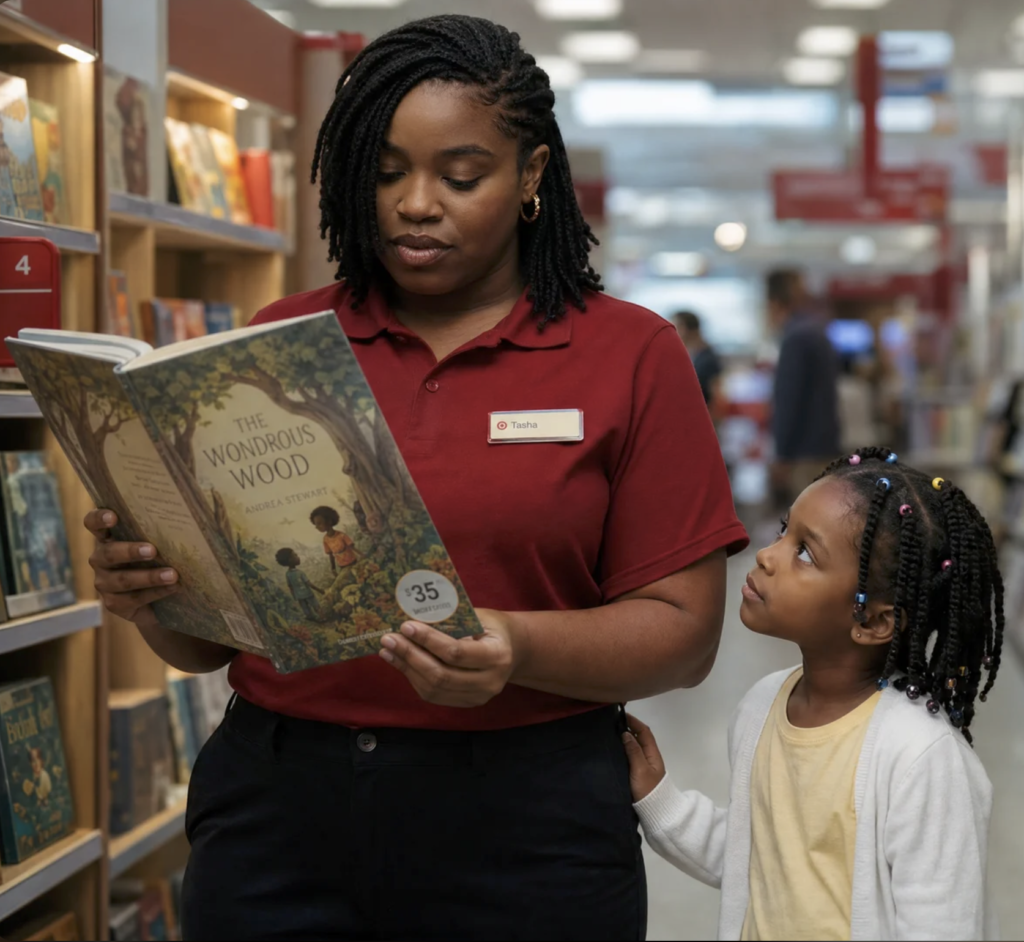
On her lunch break at a Target store in suburban Maryland last Tuesday, a 36-year-old Black mother in a red employee polo picked up a $35 children’s book in Aisle 4. A white woman in the same aisle told her, helpfully and loudly, that the discount books were in the back. Three minutes later, the cashier said the mother’s real name out loud — and the white woman heard it from two places back in line.
On her lunch break at the Target store in Silver Spring, Maryland last Tuesday afternoon — May the twenty-sixth, 2026 — a 36-year-old African American woman in a faded red employee polo shirt walked into Aisle 4 of the children’s books section, with her six-year-old daughter holding the hem of her shirt. She picked up a large hardcover illustrated children’s book titled The Wondrous Wood. It had a $35 price sticker on the back cover. She had been reading the same author’s other books to her daughter for two years. She turned the book over in her hands and read the back cover quietly. Her daughter watched her face. A 52-year-old white woman in a camel-colored cashmere cardigan, who had been browsing the same shelf three feet to their right, stepped forward gently. She smiled with the careful warmth of a woman trying to be helpful. She said, loud enough for the entire aisle to hear: “Sweetheart — those books are forty dollars. The discount section is in the back of the store, on the clearance rack.” The young mother did not look up. She did not flinch. She slowly turned the book over once more, placed it carefully in her shopping basket, gave the woman a small polite smile, took her daughter’s hand, and walked toward checkout. Three minutes later, the cashier at register seven scanned the first book, looked up, smiled at her, and said her real name aloud. The white woman from Aisle 4 was two places back in the same line. She heard it from where she stood. Her face did not move for a long time.
Her name was Dr. Tasha Renee Williams.
She was thirty-six years old. She was an associate professor of children’s literature in the Department of English at Howard University in Washington, D.C. She had earned her Ph.D. from the University of Pennsylvania in 2017, at the age of twenty-seven, with a doctoral dissertation on the cultural function of illustrated picture books in early literacy development in low-income African American households. Her dissertation had been published as a book by the University of North Carolina Press in 2019. She had won the Children’s Literature Association’s Phoenix Award for outstanding scholarship in 2021. She had been promoted to tenure in 2023. She was, at the time of the Target incident, the second-youngest tenured professor of color in Howard’s English department’s hundred-and-thirty-year history.
She was also the founder, director, and sole funder of an organization called Maya’s Library — a small reading program for children at the Silver Spring House, a transitional housing shelter for women and children fleeing domestic violence, located three quarters of a mile from the Target store where she was now waiting in checkout line. She had founded the program in 2020, in the second month of the pandemic, after her younger sister had spent six weeks at a similar shelter in Atlanta. She had named the program after her own daughter, who had been four years old at the time.
Maya’s Library currently held nine hundred and forty-eight children’s books. The four books in Tasha’s basket that afternoon — including The Wondrous Wood with its $35 price sticker — would become books number nine hundred and forty-nine through nine hundred and fifty-two.
She bought the books for the library out of her own salary every Tuesday on her lunch break. She bought them at this specific Target because the store manager, a kind Korean American woman in her fifties named Helen Park, had quietly arranged for Tasha to receive an undisclosed personal employee discount on every children’s book in the store — even though Tasha did not work at Target. Helen Park had simply liked her. Helen Park had two grandchildren who attended a Title I elementary school in Wheaton where Tasha’s nonprofit had donated three hundred books in 2022.
Tasha wore the red Target polo because she had developed, in the early months of Maya’s Library, a small habit she had not been able to break. On her lunch breaks she did not eat lunch. She walked from her Howard office to her car, drove the twelve miles to Silver Spring Target, and shopped for the week’s books for the shelter. She wore the Target polo because she had bought it for $14.99 in 2020 — the very first time she had set foot in the store — and she had discovered, that first day, that wearing it made her invisible. White customers stopped asking her where things were. White managers stopped following her down the aisles. Other Black customers had begun to ask her, quietly, if she was on a break — and they had told her, kindly, when they had thanked her, about books that had been read and re-read in their own families. She had kept wearing it. She had not been treated kindly in the store as a customer. She had been treated kindly in the store as a worker. She had chosen the kinder treatment.
The Target staff knew exactly who she was. They had known for two years. They greeted her warmly every Tuesday. They held back new shipments of beautifully illustrated children’s books for her arrival. They knew her daughter Maya by name. They knew her shelter’s needs. They knew her credit card. Three of them had read her academic book on children’s literacy in their own English night-school classes. One of them — a 22-year-old cashier named Marcus Webb — had a younger sister who had received Tasha’s recommended reading list in his middle school’s library two years earlier.
The customers did not know. The customers had never known. Tasha had never needed them to know.
Until that Tuesday afternoon — when a 52-year-old white woman in a camel cardigan named Linda Chamberlain, who had moved to Silver Spring six months earlier from a wealthy suburb of Boston, had decided to be helpful in Aisle 4.
The Daughter
Maya Renee Williams was six years old.
She had been born in October of 2019 at Howard University Hospital. She was a quiet, observant child with sharp dark eyes and a steady gaze that had unsettled hospital nurses on the day of her birth. She wore her hair in shoulder-length box braids ending in small colorful beads — yellow, pink, purple — that her grandmother Loretta had put in for her three weeks ago and that Maya had refused to let her mother redo because she had wanted to keep her grandmother’s hands on her head as long as possible.
Maya had been with her mother in Target every Tuesday for two years. She had a small canvas tote bag with her name embroidered on it. She helped pick out three to four books each week. She knew the layout of the children’s section better than the staff did. She knew Marcus Webb’s first name. She knew that the elderly Black security guard who worked the door, Mr. Henry, had a granddaughter her age in Capitol Heights. She knew the assistant manager Helen Park as Auntie Helen, which Maya had named her herself when she had been four.
She had also been told, by her mother, in the parking lot two years earlier on the very first Tuesday they had ever come, the rule that would govern every Tuesday thereafter. Maya remembered the rule perfectly. She had recited it to herself in her head every Tuesday since.
The rule was this: If anyone in the store is unkind to Mommy, Maya does not say anything. Maya does not get angry. Maya does not cry. Maya watches Mommy’s face. Maya holds Mommy’s hand if Mommy puts her hand down. When we get to the car, we will talk about it. Not before. Not in the store. The store is not a place for our feelings.
Maya, at the age of four, had asked her mother why.
Tasha had told her, in the parking lot of Silver Spring Target on a cold November afternoon in 2023: “Because some people, baby, will always see only the polo. Some people will never see the woman in the polo. Some people will not see the woman at all. Your job is not to teach them how to see. Your job is to know who your mother is. Your job is to remember. When we drive home, I will tell you everything you need to know. But in the store — your mother is just a woman buying books for the babies who do not have any. And that is a beautiful enough thing all by itself. That is enough.”
Maya had nodded slowly. She had said: “Okay, Mommy.”
She had kept the rule for two years. She had never broken it. Not once.
She had also never, in the two years before that Tuesday, witnessed any actual unkindness in the store. Helen Park and her staff had built a small protective bubble around her mother every Tuesday. Other customers ignored Tasha because she wore the polo. Maya had walked through Target every week for two years thinking the rule had been a strange and lovely thing her mother had taught her once for no reason at all.
That Tuesday afternoon in Aisle 4 was the first time she ever needed it.
The Aisle
Linda Chamberlain had moved from Wellesley, Massachusetts to Silver Spring, Maryland in November of 2025 with her husband Edward, a retired pharmaceutical executive. They had bought a four-bedroom house in a leafy neighborhood three miles from the Target. Linda had spent thirty-one years as a stay-at-home mother. Her two adult sons lived in Boston and San Francisco. Her grandchildren visited twice a year. She had recently become a volunteer at a local library’s summer reading program. She had read three articles on her phone that morning about the importance of mentoring underprivileged children.
She had walked into Aisle 4 of Silver Spring Target at 12:43 PM on Tuesday, May the twenty-sixth, looking for a birthday gift for her four-year-old great-niece in Newton, Massachusetts. She had been browsing the shelves for eight minutes when she saw a young Black woman in a Target employee polo standing three feet to her left holding a large beautiful hardcover children’s book with a $35 sticker on the back. The woman had a small child beside her. Linda saw the polo. She saw the $35 sticker. She did not see the basket already in the woman’s hand which contained three other books from the same shelf, totaling roughly $105 in retail value. She did not see the small embroidered tote bag that read MAYA on the child’s wrist. She did not see the child’s careful steady watch of her mother’s face. She did not see, on the small Target name badge clipped to the polo, that it read Tasha — Visitor in clear small print — a designation Helen Park had given her two years earlier so that Tasha could move through the store comfortably and undisturbed.
Linda saw what she had been prepared to see. She saw a young Black retail employee, on her break, holding an expensive book she could not possibly be able to afford. She felt, in that moment, a wave of warm sympathetic concern. She wanted to be helpful. She wanted, gently, to redirect this struggling young mother to the clearance rack where she could find something more reasonable for her child. She had read, just that morning on her phone, an article about how white women could be better allies to women of color in everyday situations. The article had advised offering small concrete acts of kindness.
She stepped forward gently.
“Sweetheart,” she said warmly, loud enough for the entire aisle to hear, “those books are forty dollars. The discount section is in the back of the store, on the clearance rack.”
She smiled. She waited for gratitude.
Tasha did not look up.
She was, in that moment, reading the back cover of The Wondrous Wood by Andrea Stewart — a 2024 picture book about a young African American girl who finds a hidden grove of trees behind her grandmother’s house. She had been intending to read it that night to a six-year-old child at the Silver Spring House named Imani, whose mother had been brought to the shelter eleven days earlier with two broken fingers. Tasha had been thinking about Imani’s face. She had been thinking about whether the grandmother in the book would be the kind of grandmother Imani had been missing. She had been thinking, very specifically, about the second-to-last paragraph of the book, in which the grandmother’s voice came back to the girl on the wind. She had been thinking about whether to read that paragraph twice. She had decided yes.
She heard Linda. She did not look up. She turned the book over once more. She placed it carefully in her basket. She felt Maya’s small hand still holding the hem of her polo. She felt Maya watching her face. She felt the rule between them, two years old, still perfectly intact.
She looked up at Linda for the first time. She offered a small, calm, polite smile.
She said nothing.
She took Maya’s hand. She walked past Linda down the aisle toward checkout. Linda stood in the aisle with her own browsing basket. The small polite smile of the young Black mother lingered in the air around her. She felt, briefly, satisfied. Then she felt confused. Then she felt — without yet being able to name it — the first faint discomfort of a woman who had been given a small grace she had not understood was a grace.
She turned back to the shelf.
She picked up the same book Tasha had just placed in her basket. She turned it over. She read the $35 sticker. She paused. She placed the book back on the shelf. She did not know why she had done that. She moved on to a different shelf. She picked up a much smaller paperback for $12.99. She walked toward the checkout three minutes behind Tasha and Maya.
The Register
Marcus Webb was twenty-two years old.
He had grown up in Capitol Heights. His younger sister, Imani Webb — a different Imani than the child at the Silver Spring House — was now thirteen and in the seventh grade at Drew Freeman Middle School. Marcus had worked at the Silver Spring Target for fourteen months. He was a full-time community college student in his second year at Montgomery College, majoring in elementary education. He had told his mother, two months earlier, that he had decided to become a children’s literacy teacher.
He had told his mother this because of Dr. Tasha Williams. He had not told Dr. Tasha Williams that he had told his mother this. He had been waiting for the right moment. He had decided, two weeks earlier, that he was going to ask her at her next Tuesday visit if she might be willing to write him a letter of recommendation for the elementary education transfer program at Howard, where she taught.
That Tuesday afternoon — May the twenty-sixth — was the day he had decided he would ask.
He saw Tasha and Maya approach register seven. His face lit up. He had already prepared his question in his head three times that morning. He had practiced it in the break room at 11 AM.
He scanned the first book. He looked up at her. He smiled.
“Hi, Dr. Williams,” he said warmly, in the easy casual voice he used with her every Tuesday. “Great to see you again. How are the kids loving the new library?”
Two customers back in the same line, Linda Chamberlain looked up sharply from her phone.
Tasha glanced down at Maya. Maya looked up at Marcus. A small bright proud smile crossed Maya’s face — the smile of a six-year-old child suddenly understanding, in real time, why her mother had given her the rule two years ago.
“They love it,” Tasha said softly. “We added two hundred more books this month.”
Marcus nodded. He scanned the next book. “That’s amazing. My little sister read three of your picks last week. She told me to tell you thank you.”
Tasha smiled. “Tell her I said keep reading.”
Two places back in line, Linda Chamberlain was frozen. Her phone had gone dark in her hand. Her mouth was slightly open. Her face was the face of a woman who had spent eight minutes a half hour earlier writing a long mental script in which she was the kind ally of a struggling young Black mother — and who was now realizing, in the silent space of a Target checkout line, that the young Black mother had, in fact, written her own script for the last fifteen years of her life, in which Linda had not been a character at all.
Marcus continued scanning. He glanced up.
“Dr. Williams,” he said, almost casually, as the third book went through the scanner. “Could I — uh — could I ask you something quick?”
“Of course, Marcus.”
“I’m transferring to a four-year next fall. Howard, if I get in. Elementary education. I was wondering if — when the time comes — if you might be willing to write me a recommendation letter.”
Tasha looked at him for a long moment. Her face softened. She reached across the counter and placed her hand briefly over the back of his hand.
“Marcus,” she said, “I would be honored. I’ll have it written by the end of the week. You’ll have it in your hand before you even apply.”
Marcus blinked rapidly. He looked down at his scanner. He coughed. “Thank you, Dr. Williams.”
“Thank you, Marcus.”
Two places back in line, Linda Chamberlain felt a wave of something rising in her chest she did not have a name for. She put her single $12.99 paperback down on the small display table beside her. She turned. She walked out of the checkout line. She did not buy anything that day. She walked out the front doors of Silver Spring Target carrying nothing. She sat in her car in the parking lot for twenty-three minutes without starting the engine.
Inside the store, Tasha paid. She tucked her receipt into her pocket. She placed the Target bag of four books into Maya’s small hands.
She turned. She walked toward the front of the store with her daughter beside her. She did not look at the empty spot in line where Linda Chamberlain had been standing two minutes earlier. She walked past it without registering it as worth her notice. Maya glanced once at the empty spot. She did not say anything. She had been taught the rule.
They walked through the front sliding doors into the warm May afternoon.
The Parking Lot
Tasha unlocked her car — a six-year-old silver Honda Accord she had bought used in 2020 because she had quietly redirected what she would have spent on a newer car each year into Maya’s Library. She opened the back door. She helped Maya into her booster seat. She buckled her in. She placed the bag of four books on the seat beside her daughter.
She closed the back door. She walked around to the driver’s side. She got in. She did not start the engine. She turned around in her seat to face her daughter.
“Maya,” she said quietly. “Do you remember the rule?”
Maya nodded.
“Did you keep the rule today?”
“Yes, Mommy.”
“Are you proud of yourself?”
“Yes, Mommy.”
Tasha looked at her daughter for a long moment. Then she said the thing she had been waiting two years to say. She had not known, until that Tuesday afternoon, that she had been waiting to say it. She had not known the moment was coming. It had come anyway.
She said: “Baby. I want to tell you something. That woman in the aisle today did not see me. She saw something else. She saw a polo. She saw a price sticker. She did not see your mother. She did not see Dr. Williams. She did not see the woman who teaches at Howard. She did not see the woman who is going to send Marcus to Howard with a letter she will write this week. She did not see the woman who has bought nine hundred and forty-eight books for children who do not have any. She did not see any of those women, Maya. She did not even see me.”
She paused. Maya was watching her face very carefully.
“Here is what I want you to remember,” Tasha continued. “What that woman saw — that is her story. It is not my story. It is not your story. Her story is small, baby. Her story is going to keep her small. She is going to drive home today, and she is going to sit at her kitchen table, and she is going to be uncomfortable for a long time, because she is going to remember, every time she looks at a Black woman in a uniform for the rest of her life, that one day she said something to one of them that turned out to be the wrong thing to say. That is going to follow her. That is hers to carry, Maya. Not mine. Not yours. Hers.”
She reached back and took Maya’s small hand.
“My story is different,” she said. “My story is that I have a daughter named Maya who knew, at six years old, how to hold her tongue in a place where most grown men cannot. My story is that I went to college. My story is that I went to graduate school. My story is that I built a small library for babies who did not have one. My story is that I had a son today named Marcus who asked me for a letter, and I said yes. My story is that I am going to drive home with my daughter and I am going to read her The Wondrous Wood tonight, and I am going to read the second-to-last paragraph twice, the way I had been planning to read it. That woman in the aisle — she does not get to be in my story today, baby. She does not get a single sentence.”
She paused.
“Do you understand, Maya?”
Maya was quiet for a long moment. Then she said, in her small clear voice: “Mommy. I understand. But I am going to write her a sentence anyway. In my head. So she gets one sentence. Just one.”
Tasha laughed softly. She wiped a single tear from the corner of her eye with the back of her hand.
“What is the sentence, baby?”
Maya thought for a moment. She straightened her small shoulders against the booster seat.
She said: “She did not know my mother. So my mother let her not know. And that was a kindness, too.”
Tasha sat very still in the driver’s seat. She did not speak for a long moment. Then she reached back and squeezed her daughter’s hand.
“Yes, baby,” she said softly. “That was a kindness, too.”
She started the engine. They drove home.
What Happened Next
That night, in the small front room of a transitional housing shelter at the corner of Sligo Avenue, Tasha Williams sat on a beige donated couch and read The Wondrous Wood aloud to a six-year-old child named Imani, whose mother sat on the floor at her feet with a half-healed cast on her right hand. Tasha read the second-to-last paragraph twice. When she finished, Imani had her head against her mother’s good shoulder. She had fallen asleep one sentence before the end. Her mother was crying quietly. Tasha closed the book. She set it on the small wooden coffee table. She did not say anything. She left the book there.
It became book number nine hundred and fifty-two of Maya’s Library.
It is still on that coffee table. Imani has had it read to her by her mother seventeen times since that night.
Three weeks later, a 22-year-old young man named Marcus Webb received a thick cream envelope in the mail at his mother’s home in Capitol Heights. Inside was a four-page handwritten letter from Dr. Tasha Williams. The letter described, in careful clear handwriting, every single observation Tasha had made of Marcus’s character over the previous fourteen months — his patience with elderly customers, his quiet warmth with children, the way he stocked the shelves at the children’s section with the kind of attention a teacher gives a lesson plan. The letter described, in its third page, a single specific Tuesday afternoon in May of 2026 when Marcus had asked her — at a checkout register, in a Target store in Silver Spring, in front of a complete stranger who had just been unkind to her in the aisle — whether she might be willing to recommend him for transfer to Howard. The letter noted that Marcus had not waited for a better moment. That Marcus had not let the smaller cruelty of the room interrupt the larger kindness of his own intention. That this — being able to hold a clear purpose in an unkind room — was the most valuable thing a teacher of small children could possibly possess.
Marcus Webb began his transfer year at Howard University in the fall of 2026 on a full academic scholarship. He is currently completing his bachelor’s degree in elementary education. He has already accepted a position to begin teaching second grade at Burrville Elementary in Northeast D.C. in 2028.
Helen Park, the assistant manager of Silver Spring Target, was promoted to store manager in October of 2026.
Linda Chamberlain, the 52-year-old white woman in the camel cashmere cardigan, drove home that afternoon. She sat at her kitchen table for two hours. She did not tell her husband Edward what had happened. She did not tell her grandchildren. She did not tell anyone, for a long time. In November of 2026, six months after the Target incident, she walked into the Silver Spring House — the same shelter where Tasha Williams ran Maya’s Library — and asked the front desk volunteer if there was anything she could do to help. She was assigned, after a background check, to the Tuesday afternoon literacy hour. She has been there every Tuesday for the past six months. She reads books aloud to children. She has never seen Tasha Williams there. The shelter staff have not told her, and will not tell her, that Tasha Williams is the founder of the program in which she now volunteers, or that the books Linda reads from are the books Tasha personally selects each Tuesday on her Target lunch break. Linda has never asked. The shelter has not offered the information.
Linda has not entered a Target store since May of 2026. She has been told by her husband Edward that this is irrational. She has been unable to explain to him why.
Maya Williams is now seven years old. She has kept the rule for a third consecutive year. She has never broken it. Not once.
She has, however, written one sentence in her head every Tuesday afternoon, in the Target parking lot, for the last fifty-two Tuesdays.
She has never spoken any of those sentences aloud.
She has told her mother, on the eve of her seventh birthday, that she is saving them for when she is older. That she is going to grow up and write a book one day. That the book is going to be called The Sentences I Did Not Say. That the book is going to be dedicated to her mother, and to a woman in Aisle 4 whose name she never learned, and to the Marcus who got the letter, and to the Imani whose mother could not hold the book, and to her grandmother Loretta who had put the beads in her hair three weeks before any of it ever happened.
Her mother had laughed softly. She had asked Maya what the first sentence of the book would be.
Maya had thought about it for a long time. Then she had said:
“Mommy. The first sentence is — my mother taught me that the smallest kindness in the world is the kind you give to a stranger who does not know they need it.”
Tasha had been silent for a long moment.
Then she had said only: “Baby. That is a beautiful first sentence. You keep that one. You hold it. You hold it for the rest of your life.”
“Yes, Mommy.”
“And one day — when you are ready, baby — you write the rest of the book.”
“Yes, Mommy. I will.”
It is on her shelf still, in her bedroom on the second floor of their small house in Silver Spring. A composition notebook with a blue cover. The first sentence is already written in pencil, on the first page, in a seven-year-old’s careful handwriting. The other 947 pages are still blank.
She is, at the time of this writing, working on the second sentence.
Continue Reading
More stories you’ll love
The Name She Never Used
She buried it for sixty-two years. Then a ten-year-old girl handed her an envelope at brunch…
The Coffee Lady
For 30 years they laughed at her cheap shoes. They never noticed the notebook in her purse…
The Woman at Pew Seven
Every pew at the funeral was full — except for the one in the back, where a woman nobody recognized had been waiting fifty-five years to say goodbye…