
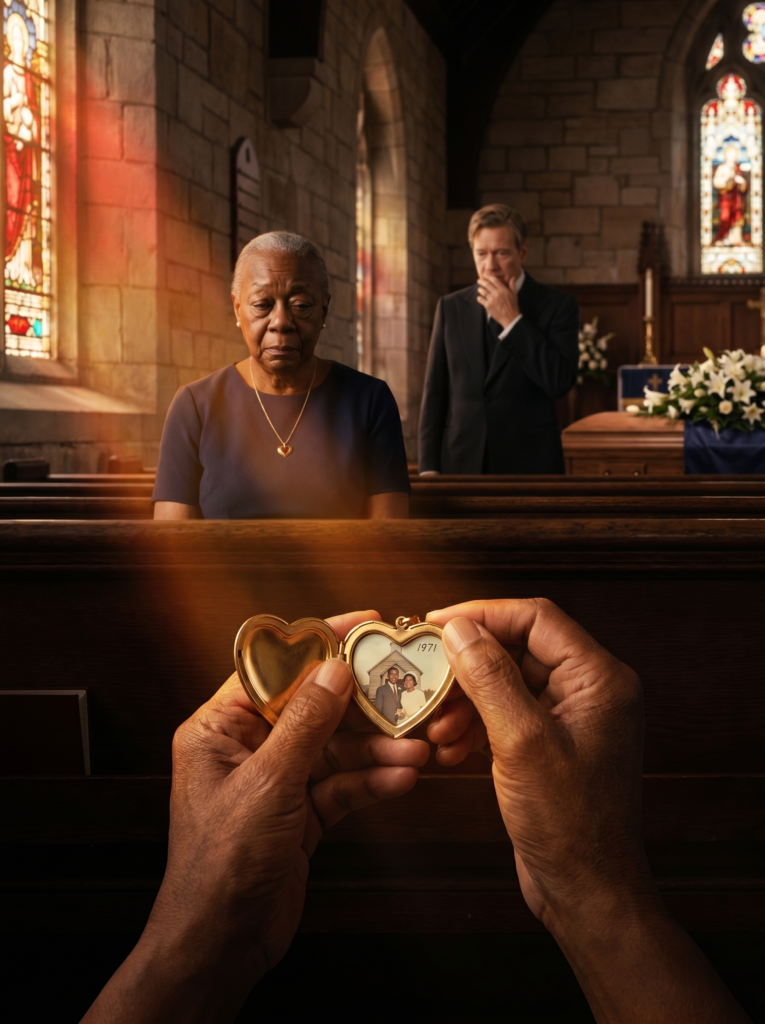
The Woman at Pew Seven
Every pew at the funeral was full — except for the one in the back, where a woman nobody recognized had been waiting fifty-five years to say goodbye.
At Edward Whitfield Senior’s funeral last Tuesday at Trinity Episcopal Church in Boston, every pew was full. Senators were there. Two former judges. The president of Harvard Law School. The mayor’s chief of staff. Four hundred mourners in black, three eulogies, white lilies cascading over the oak coffin. The only empty seat in the entire sanctuary was the one beside the elderly Black woman in pew seven. She sat alone for the entire service. Nobody recognized her. She held a small gold locket in her hand the whole time. And when his son James walked over to her after the final hymn, she opened it — and rewrote the story of an entire family in ninety seconds.
Her name was Ruth Mae Carter.
She was seventy-four years old. She had been born in 1951 in a small town called Mound Bayou in the Mississippi Delta, the youngest of five children of a Baptist preacher and a schoolteacher. She had taught third grade in the local public school for forty-one years before she retired. She lived alone in a small house with a porch swing and a vegetable garden, in the same town where she had been born. She had never been to Boston before in her life.
She had arrived the day before the funeral, on a Greyhound bus, with one small suitcase, a black church dress that had belonged to her mother, and the gold locket she had not taken off since the summer of 1971.
The Summer of 1971
Ruth Mae was nineteen years old in the summer of 1971. Edward Whitfield was twenty-one. He had just finished his junior year at Harvard. He had come down to Mississippi as a volunteer with a small civil rights organization that was helping Black communities register to vote and document segregation-era injustices that the federal government had quietly stopped investigating.
Edward was from old Boston money. His father was a federal judge. His grandfather had been a United States senator. The Whitfields had been quietly powerful in Massachusetts for four generations. He had grown up in a townhouse on Beacon Hill, summered on Martha’s Vineyard, and attended Phillips Exeter Academy before Harvard. He had told no one in his family where he was spending the summer.
He arrived in Mound Bayou in June with a borrowed station wagon, three notebooks, and a sense of urgency that he could not articulate. He stayed in a spare room in the home of Reverend Carter, Ruth Mae’s father. He ate dinner with the family every night. He helped Mrs. Carter weed the garden in the mornings. He taught Ruth Mae’s younger nieces how to throw a baseball.
Ruth Mae did not like him at first. She thought he was just another well-meaning white college boy who would spend three months in their lives and then go back to Cambridge and never think about them again. She told him so, plainly, on the third week, while they were sitting on the porch swing one evening.
Edward did not get defensive. He listened. He told her she was probably right, but he hoped she was wrong. Then he asked if she would have dinner with him in town on Saturday night.
She said no.
He asked again the next Saturday. And the one after that. By the fifth week of the summer, she said yes.
They fell in love quietly. She would say later, when she finally told the story to her daughter in 2018, that she had not believed it was real until the morning he asked her father for his blessing to marry her, in the small wooden Carter family church on the edge of town. Her father had wept. He had said yes.
They were married on August the fourteenth, 1971, in that same church, in front of twenty members of her family, two of Edward’s friends from college, and a wedding photographer who was Ruth Mae’s cousin. It was a small ceremony. She wore a white cotton dress her mother had sewn. He wore a borrowed grey suit. They had no rings. They could not afford them. He promised her gold rings by Christmas.
They were married for four months.
What His Family Did
The Whitfields found out in early December of 1971. Edward had returned to Harvard for the fall semester. He had been writing Ruth Mae three letters a week. He had been planning to bring her north in January after Christmas, to introduce her to his family, to find them an apartment in Cambridge, to begin their life together.
His father, Judge Edward Whitfield, found one of the letters in his son’s dorm room during a visit to Cambridge that December.
The judge did not raise his voice. He did not threaten his son in any obvious way. He did what powerful men in Boston did in 1971 when their sons made decisions the family could not afford. He flew to Mississippi with two attorneys. He met with Reverend Carter in the kitchen of the Carter family home. He did not meet with Ruth Mae.
He told the Reverend that the marriage could be annulled cleanly, with the Reverend’s cooperation, in the state of Mississippi, where mixed marriages were still socially unacceptable and legally fragile. He told the Reverend that if the marriage was not annulled, he would use his federal connections to ensure that the small Mississippi civil rights organization that Edward had volunteered for that summer would be investigated, audited, and dismantled. He named four other Black families in town that he could harm through his connections. He told the Reverend that Ruth Mae would be paid twenty thousand dollars in 1971 money — the equivalent of about a hundred and forty thousand dollars today — for her cooperation and her silence.
Reverend Carter sat at his kitchen table and listened to a federal judge calmly explain how he would destroy his community if his son was not given back. The Reverend did not weep until later that night, in his own bedroom, with the door closed.
Ruth Mae signed the annulment papers ten days later. She also signed a confidentiality agreement that prohibited her from ever contacting Edward Whitfield, or any member of his family, for the rest of her life. The agreement included a clause about damages — financial and otherwise — if she ever revealed the marriage publicly.
She accepted the twenty thousand dollars. She used it, four years later, to pay for medical school for her older sister’s son, who would go on to become the first Black pediatrician in their county.
Edward Whitfield never knew about the negotiation. He never knew his father had threatened the Carter community. He was told, by his father, that Ruth Mae had decided the marriage was a mistake. He was shown a forged letter, in Ruth Mae’s handwriting, that said she did not love him and never had. He believed it. He was twenty-one years old. He had no other information. He came home for Christmas in 1971 a different man. His father had broken something in him that would not heal for the rest of his life.
What She Did Not Know
Ruth Mae was three weeks pregnant on the day she signed the annulment papers. She did not know it yet. She found out in February of 1972.
She did not tell Edward. She did not tell anyone outside her immediate family. The confidentiality agreement she had signed was very specific about contact with the Whitfields, and her father had explained to her, quietly, that the judge’s threat to the community was not theoretical. Other families could be hurt. Other lives could be ruined. She made a decision in February of 1972 that she would live with for fifty-four years.
She raised her daughter alone. She named her Naomi, after the Biblical mother-in-law who lost her husband and her sons and refused to be bitter. She told Naomi that her father had been a kind young man from the north who had died before she was born. She showed Naomi the gold locket once, when Naomi was nine years old. She told her it had a picture of her father in it. She did not let her open it.
Naomi grew up. She went to Howard University on scholarship. She went to medical school at the University of Mississippi. She became a pediatrician, like her cousin. She moved to Atlanta. She married a kind man named David. She had two children of her own. She visited her mother every other weekend.
Ruth Mae kept her promise. She did not contact Edward. She did not respond to the four letters he sent her in the spring of 1972 — letters she did not read until 2026, because they had been intercepted by her father, who burned them in the wood stove without telling her. The Reverend believed, all his life, that he was protecting his daughter. He went to his grave in 1989 still believing it.
She did not know about the other letters.
The Letters
In April of 1972, Edward Whitfield was twenty-two years old. He had been told for four months that the woman he loved had abandoned him. He had been quietly miserable. He had graduated from Harvard in May. He had been admitted to Harvard Law School. He was scheduled to begin in the fall.
In late April, while packing his dorm room, he found a small gold locket at the bottom of a desk drawer — a locket he had bought in a Mississippi pawn shop in August of 1971 and given to Ruth Mae the day before their wedding. Inside the locket was a small photograph of the two of them in front of her father’s church. He did not understand how it had gotten back into his possession. He suspected, correctly, that his father had something to do with it.
He sat down at his desk that night and wrote her a letter. He did not send it. He did not have her address — his father had had all of her correspondence destroyed. He kept it. He wrote her another letter a year later, on the same date — August fourteenth, the anniversary of their wedding. He kept that one too. He wrote a letter every year for fifty-four years.
He never married for love. He married a Boston woman his family chose for him in 1976, a kind woman named Margaret who became a kind mother to their three children. She knew. She had always known that her husband loved someone else, somewhere else, that she had never met and would never replace. She did not resent him for it. She had her own reasons. Their marriage was a quiet partnership of two people who had each given something up. It was not unhappy.
Margaret died in 2019. Edward retired from his law firm in 2020. He spent the last six years of his life writing. He wrote a memoir he did not publish. He wrote letters to his grandchildren he asked them not to open until after his death. He wrote, every year, on August the fourteenth, another letter to Ruth Mae.
In total, between 1972 and 2026, he wrote her fifty-four letters. He kept them in a leather binder in a safety deposit box at the Boston Private Bank. He left written instructions with his attorney that, upon his death, the binder was to be opened and the letters were to be mailed, all at once, to a specific address in Mound Bayou, Mississippi, that he had hired a private investigator to find for him in 2015.
He died on May the third, 2026, of pancreatic cancer, at the age of seventy-five. His attorney executed his instructions four days later.
Ruth Mae received the package on May the ninth.
What She Read
She read all fifty-four letters in one night.
She started at eight in the evening, sitting at her kitchen table with a cup of tea that went cold. She finished at four in the morning. She did not eat. She did not sleep. She read each letter in chronological order, beginning with the first one Edward had written her in April of 1972, when he had still thought she had left him voluntarily.
The early letters were angry. Hurt. Confused. He asked her how she could have done what she did. He told her he had loved her. He told her he had been planning their life. The middle letters, written through the 1980s and 1990s, were sadder, more resigned, more contemplative. He wrote to her about his children. About his work. About a case he had argued before the First Circuit Court of Appeals that he thought she would have been proud of. About his mother dying. About his father dying, in 1998, and what he had felt at the funeral, which was not grief but a kind of cold release.
It was in a letter dated August the fourteenth, 2001 — thirty years after their wedding — that he had finally learned the truth. He had gone through his late father’s papers and found the file. The annulment. The threats. The forged letter. The twenty thousand dollars. The names of the families his father had threatened.
That letter — letter number thirty in the binder — was the one Ruth Mae read three times. It was a letter of apology that contained no excuses. He did not ask for her forgiveness. He told her, simply, what his father had done. He told her he had not known. He told her that he understood, now, why she had signed the papers, and that he would understand, until the day he died, that she had been protecting people he had never met. He told her she was the bravest person he had ever known.
He ended that letter with these words: I do not deserve to know you. But please know that I have never, in fifty-four years, stopped loving you. I will continue to write until I die. You do not have to read these. But I cannot stop writing them.
Ruth Mae read the last letter at three forty-five in the morning. It was dated April the twentieth, 2026, two weeks before he died. He had written it from a hospital bed. His handwriting was shaking but legible.
It said: Ruth — if I am ever buried, please be the last one who weeps for me. I do not want to be remembered by the people who loved who they thought I was. I want to be remembered by the one who knew who I tried to be.
She sat at her kitchen table at four in the morning. She did not cry yet. She read the obituary that had been included in the package. The funeral was scheduled for May the nineteenth at Trinity Episcopal Church in Boston, at one in the afternoon.
She got up. She bought a Greyhound ticket online. She packed the black dress that had belonged to her mother. She put the locket around her neck.
She went to Boston.
The Service
She sat in pew seven, near the back. She did not introduce herself to anyone. She did not speak to anyone. She watched a man she had loved for fifty-five years be eulogized by three people who did not know him.
His oldest son James spoke first. James was fifty-four years old, a partner at a major Boston law firm, articulate and composed. He spoke about his father’s career. About his father’s commitment to public service. About his father’s quiet kindness at home. He spoke for nine minutes. He did not cry.
A federal judge spoke after James. A senator spoke after the judge. The eulogies were dignified, accomplished, accurate to the man Edward Whitfield had publicly been. They said nothing about who he had actually been. They could not have. They did not know.
Ruth Mae listened to all of it. She held the locket in her hand. When the final hymn was sung — Be Thou My Vision, which had also been sung at their wedding in Mound Bayou in 1971 — she closed her eyes and let one tear roll down her cheek.
The service ended. The mourners began to leave in a slow procession. The Whitfield family lingered near the front, accepting condolences.
Ruth Mae did not move from pew seven.
James Whitfield noticed her as he walked down the side aisle. He had seen her during the service — the only person in the entire sanctuary not in black, the only one sitting alone. He had assumed she was a former secretary at his father’s firm. Or perhaps a domestic worker his mother had employed years ago. He thought it would be kind to thank her for coming.
He walked over to pew seven. He sat down beside her, the empty seat between them. He spoke softly.
“Ma’am, I’m James Whitfield. Edward was my father. Thank you for coming all the way here today. Were you a friend of his?”
Ruth Mae looked at him. She studied his face. She had seen his face only in photographs in the newspaper. He had his father’s eyes. He had his father’s jaw. He did not have his father’s gentleness — not yet, perhaps not ever.
She did not speak right away. She lifted the gold locket from where it rested against her chest. With careful, slow fingers, she opened it.
She turned it toward James.
Inside was a faded photograph from August of 1971. A young man, twenty-one years old, in a borrowed grey suit, smiling so widely that he looked like a stranger. A young Black woman, nineteen years old, in a white cotton dress her mother had sewn. They were standing in front of a small wooden church. They were holding hands. They were looking at each other.
James looked at the photograph for a long time.
He did not understand what he was looking at. Then, slowly, he did.
His hand went to his mouth. He looked at Ruth Mae. He looked at the photograph. He looked at the coffin at the front of the church. He looked at his mother’s framed photograph that had been placed on the altar — Margaret Whitfield, dignified, kind, deceased seven years.
He looked back at the photograph in the locket.
“That’s my father,” he said. His voice was very quiet.
“Yes,” Ruth Mae said. Her voice was gentle. Her Mississippi accent was soft after fifty-five years. “He was twenty-one.”
“Who are you?”
She smiled, very softly.
“My name is Ruth Mae Carter. Your father and I were married in Mississippi on August the fourteenth, nineteen seventy-one. We were married for four months. His family ended it. We never saw each other again.”
James did not speak. He could not speak.
Ruth Mae continued, quietly, in the empty back pew of a church that was slowly emptying.
“Your father was a good man who was not allowed to be brave. The world made him choose. He never stopped loving the wrong things. He wrote me letters for fifty-four years. I never received them. He left them for me when he died. I read them last week. I came to say goodbye.”
She closed the locket. She placed it gently in James’s open palm. She closed his fingers around it.
“This is yours now,” she said. “Open the back of it when you get home.”
She stood up. She gathered her purse. She did not give him her phone number. She did not give him her address. She walked out of Trinity Episcopal Church into the bright May afternoon, and she did not look back.
What Was Inside the Locket
James drove home to his house in Brookline that evening in a daze. He sat alone in his study with the locket in his hand for two hours before he opened it.
Inside the front, behind the photograph, was a tiny folded piece of paper. He unfolded it carefully. It was a note in his father’s handwriting, dated August fourteenth, 1971 — the day of the wedding.
It said: Ruth — if I am ever buried, please be the last one who weeps for me.
James read it three times. He sat in his study for the rest of the night. He did not sleep.
At six in the morning, he called his father’s old attorney. He asked for an address in Mound Bayou, Mississippi. The attorney, a discreet man who had executed Edward Whitfield’s final instructions, gave him the address.
James drove south. He drove for twenty-eight hours, stopping only for gas and coffee. He arrived in Mound Bayou at three the next afternoon. He found a small house with a porch swing and a vegetable garden. He sat in his car for ten minutes before he had the courage to walk up the path.
Ruth Mae answered the door. She was wearing a cotton apron. She had been making cornbread.
“You’re early,” she said quietly. “I figured you might come, but I thought it’d take you a week.”
She invited him in.
She made him a plate of cornbread and beans. She made him a cup of coffee. They sat at her kitchen table. He did not know how to begin.
“There is something I need to tell you, James,” she said gently. “I should have told you yesterday. But I needed to know you would come.”
She got up. She went to a cupboard above the refrigerator. She brought down a small framed photograph. She placed it in front of him.
It was a photograph of a Black woman in her early fifties, in a white coat, with a stethoscope around her neck, standing in front of a hospital. She had Ruth Mae’s eyes. She also had James’s father’s jaw.
“This is my daughter Naomi,” Ruth Mae said softly. “She is a pediatrician in Atlanta. She is fifty-four years old. She was born in August of nineteen seventy-two. She has two children of her own. Her son is fourteen. Her daughter is eleven.”
She paused. She looked at James across the small kitchen table.
“She is your sister. Your father never knew. I have never told her about him. I think it is time, James. But that is your decision and hers, not mine.”
James Whitfield put his head in his hands and wept at the kitchen table of a woman he had not known existed seventy-two hours earlier. Ruth Mae sat across from him. She put her hand over his hand. She did not speak. She let him cry.
When he finally lifted his head, she smiled at him gently.
“Your father was not a coward, James. He was a young man who was given an impossible choice by a powerful father. He spent fifty-four years trying to atone for it. He could not undo what was done. But he could love. And he did. Quietly. Without permission. Until the day he died.”
She paused.
“Now you go home. You think about what you want to do. If you want to meet your sister, you write to me. I will tell her. If you do not, that is alright too. The world owes nobody anything. But your father wanted you to know. And so do I.”
James left that evening. He drove back to Boston. He did not write to Ruth Mae for two weeks. He thought. He talked to his wife. He talked to his two younger brothers, who were as stunned as he was. He prayed for the first time in years.
He wrote to Ruth Mae on June the tenth. The letter was short.
It said: Mrs. Carter — I would like to meet my sister. I would also like to come back to your kitchen one day, if you will have me. — James
Ruth Mae wrote back the same week.
Her letter said: Come on Sunday. Bring your family. There is room at the table.
Continue Reading
More stories you’ll love
The Name She Never Used
She buried it for sixty-two years. Then a ten-year-old girl handed her an envelope at brunch…
The Janitor at the Back of the Auditorium
For 32 years he cleaned their hallways. At commencement, a Supreme Court Justice walked off the stage to find him…
The Coffee Lady
For 30 years they laughed at her cheap shoes. They never noticed the notebook in her purse…