
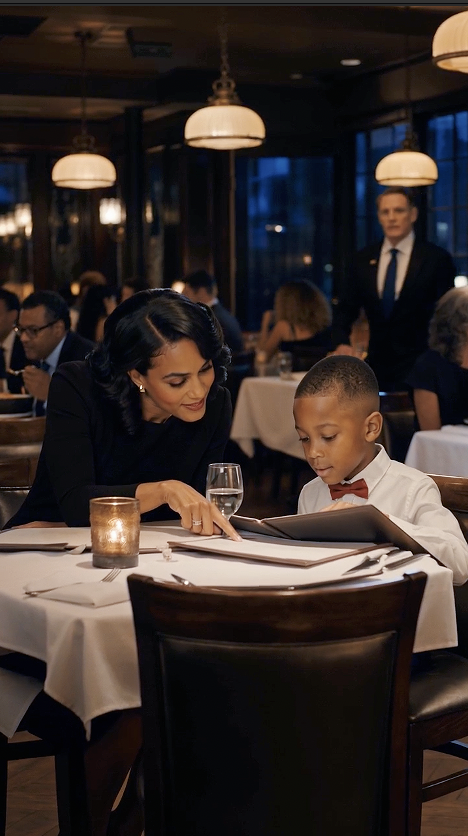
The Boy at the Restaurant
At an upscale Italian restaurant in downtown Atlanta last Friday evening, a 35-year-old Black mother and her 8-year-old son in a small red bow tie sat down at a candlelit window table for the boy’s birthday dinner. The white maître d’ walked over briskly and told them, loud enough for the neighboring tables to hear, that they would need to move to the bar area. The boy looked up at him and said the name on the building.
It was a Friday evening in downtown Atlanta, just before eight o’clock, and the city had slipped into that deep blue twilight that always seems to make a restaurant window look like a painting. Inside one of the most quietly respected Italian dining rooms in the city — dark walnut paneling, white linen tablecloths, a single flickering candle in a smoky glass holder at the center of every table — a 35-year-old African American woman in a simple tailored black sheath dress sat across from her son at a small two-top near the windows. Her elegant shoulder-length waves caught the warm amber pendant light overhead. A thin gold necklace at her throat. Small gold studs in her ears. Across from her, sitting upright in his chair with the careful posture of a child who had been told, very seriously, that this dinner was a special one, was an eight-year-old boy in a crisp white collared shirt, navy dress pants, a thin brown belt, and a classic red clip-on bow tie his grandmother had given him that afternoon. His name was James Hartley. It was his eighth birthday. He was reading the menu with his mother’s quiet help, his small finger tracing the line under each word. A small wrapped present sat on the table beside her menu — a gift she was planning to let him open when his father and grandmother arrived in about ten minutes.
They had been seated by the young hostess at the front about three minutes earlier. The reservation had been made the previous week, under the name Hartley, for a window two-top at 7:45 PM, with a note in the booking that a young Hartley party would be celebrating a birthday. Adrienne Hartley had checked in calmly at the host stand. The hostess had smiled, found the booking on the screen, and walked them to the candlelit table herself.
The maître d’ had not been at the host stand when they arrived. He was in the back, near the kitchen, going over the evening’s covers with the floor manager. His name was Gerald. He was a 50-year-old white man in a perfectly tailored black two-piece suit, a crisp white dress shirt, a sleek dark navy silk tie, and a small gold restaurant pin on his lapel. He had been the front-of-house manager of this restaurant for sixteen years. He had worked the door at fine Italian restaurants in Atlanta for the thirty years before that. He was, by every measure he cared about, a professional.
He came out of the back, glanced across the dining room, and saw the two-top by the window. He frowned slightly. He picked up the small podium clipboard from the host stand. He looked at the seating chart. He looked at the table. He set his shoulders. And he walked briskly across the dining room toward Adrienne and her son.
The Dismissal
He arrived at the right side of their table and leaned slightly down, his polished professional briskness fully assembled. He spoke loud enough for the two neighboring tables to hear — not cruel, in the way he understood cruelty, but firm, the way a man speaks when he is delivering bad news he does not consider bad.
“Excuse me,” he said. “This table is reserved for the Hartley party. You’ll need to move to the bar area, or wait outside until something opens up.”
Two diners at the adjacent table glanced over. A wine glass paused on its way to a mouth.
Adrienne Hartley did not raise her voice. She did not pull out her phone. She did not reach for her wallet. She looked up at the maître d’, blinked once, and looked across the candle at her son. She had heard this tone many times in her life. She had heard it in lobbies and at front desks and at the doors of rooms her family had every right to be in. She had stopped letting it surprise her years ago. She did not say anything at all. She simply waited, with the patience of a mother who had decided, a long time before this Friday, that some moments belonged to her son.
James looked up at Gerald. His small chin lifted, very slightly. His expression did not change. He had been raised, his whole short life, to be exactly this prepared. He spoke in the clear young voice of a child who had rehearsed nothing and meant every word.
“My name is James Hartley,” he said. “The reservation is mine. My dad made it last week. He’s the one who owns the restaurant.”
Gerald’s polished smile faltered. His head tilted, very slightly, in mild confusion. His mouth was still half-open from his previous sentence. He glanced down at the podium clipboard he was still holding from the host stand — at the seating chart, at the booking name, at the small handwritten note on the morning’s reservations list.
James continued, gently, the way his father had taught him to finish what he meant to say.
“My dad is coming in ten minutes. He’s bringing my grandma. It’s my birthday. We’d like our table now, please.”
Across the table, the trace of a small private smile appeared at the corner of Adrienne Hartley’s mouth — pride, restraint, the satisfaction of a mother whose eight-year-old son had just said the four sentences he had been raised, his whole life, to be ready to say. She folded her hands on the white linen tablecloth and watched the maître d’s face.
Gerald’s face drained.
The Phone Call That Morning
Because Gerald had, in fact, been on the phone with a Mr. Hartley that very morning, just after ten o’clock. Mr. Hartley had called to confirm a 7:45 PM booking. Mr. Hartley had asked Gerald, personally, to make sure the window two-top was set up for a young Hartley party. Mr. Hartley had specifically mentioned that his son James would be coming for his eighth birthday. Mr. Hartley had been polite, brief, and direct. Gerald had said “absolutely, Mr. Hartley” three times and put down the phone and made a note in his book and not thought about it again.
What Gerald had not known — what almost no one on the floor staff had known — was who Mr. Hartley was.
The restaurant had been quietly purchased six months earlier, in a private transaction worth just under four million dollars, by a 41-year-old African American restaurateur named Marcus Hartley. Marcus had been turning around five Atlanta restaurants over the previous decade. He had walked into struggling kitchens, fixed them, and made them shine. He was respected, in restaurant circles, as one of the sharpest operators in the South. And he had made a deliberate decision, when he bought this restaurant, not to introduce himself to his front-of-house staff for the first six months. He had wanted to learn how the restaurant ran when no one in it knew he owned it. He had wanted to see who his real managers were when the boss was not watching.
James had asked him, the week before his birthday, if they could have his birthday dinner at his dad’s restaurant. Marcus had said yes. He had made the reservation under his own name. He had called Gerald, personally, that morning, to confirm the window table for his young Hartley party. And he had sent his wife and son ahead, twenty minutes early, exactly the way they would have arrived if they were any other family in Atlanta with a Friday-night reservation.
To see what would happen.
The Long Quiet Moment
The maître d’ stood beside the candlelit table with the podium clipboard still in his hand, and his eyes moved from the eight-year-old in the red bow tie to the calm mother across the table, and the full weight of his Friday evening landed on him in complete silence. A small bead of cold sweat began at his temple in the warm pendant light. His hand, the one not holding the clipboard, moved very slightly toward the other, in the small involuntary gesture of a man beginning to assemble an apology he does not yet have the words for.
He took a small step backward from the table.
The two diners at the adjacent table were now openly watching. So was the couple two tables over. So was the hostess at the front, who had begun to understand what she had just witnessed and who had quietly set down the menus in her hand.
James, the eight-year-old whose name was on the building he was sitting in, did not say anything else. He simply picked up his menu again and went back to studying the antipasti. Adrienne, across the table, reached for the small carafe of sparkling water at the side of the table and poured her son a glass. The ice clinked softly. The string-quartet recording on the restaurant’s speakers shifted into the next movement.
“Some bread for the table, please,” Adrienne said gently, without looking up. “And a glass of the house red for me. Thank you, Gerald.”
Gerald said, very quietly, “Yes, ma’am.” He turned. He walked toward the kitchen with his clipboard held against his chest like a small shield. He did not look back at the table.
Marcus Hartley Arrives
Marcus Hartley arrived eleven minutes later, with his mother on his arm — a 68-year-old woman in a deep green wrap dress and pearls — and the room shifted in the way a room shifts when the owner of a place walks through the door and the staff who have not known him for six months suddenly understand who he is. The hostess straightened. The floor manager appeared from the back. Gerald, who had been waiting near the bar with a face the color of paper, walked over. Marcus shook his hand. Marcus did not raise his voice either. Marcus said only, “We’ll talk on Monday, Gerald.”
And then Marcus walked across the dining room, kissed his wife on the top of her head, sat down beside his son, and asked the eight-year-old in the red bow tie how the menu was looking.
James said, “Dad. I think I want the spaghetti.”
Marcus said, “Then that’s what we’re having.”
The wrapped present was opened between the appetizers and the main course. It was a small wooden picture frame the grandmother had built herself in her woodworking class, with a photograph inside of James standing beside his father at the construction site of the restaurant they were now eating in, taken eighteen months earlier, before the renovation, when the dining room had been bare brick walls and dust. James looked at the photograph for a long time. He looked up at his father. He said, “Dad. Did I really stand there?”
Marcus said, “You really did, son. You were six. You held the blueprint.”
And the eight-year-old at the candlelit window table on his birthday, in the restaurant his father had quietly bought six months earlier and run anonymously to see who his real people were, picked up his fork and began, very carefully, to eat his birthday dinner.
What Happened on Monday
Outside the tall windows, downtown Atlanta had gone fully dark. The candle between them flickered once. The string-quartet recording shifted again. The neighboring tables, the ones that had been watching, returned to their own dinners with the slightly self-conscious quietness of strangers who had just witnessed something they had not paid for.
Marcus Hartley did not fire Gerald that evening. He did not embarrass him in front of the dining room. He did not call him into the kitchen. He shook his hand once. He said, “We’ll talk on Monday.” And then he went and sat with his son.
On Monday morning, at nine o’clock, Marcus Hartley met Gerald in the small office above the kitchen. The conversation lasted twenty-three minutes. The door was closed. The floor manager, who had been working at the restaurant for nineteen years and had been one of the only floor staff Marcus had personally interviewed during the purchase six months earlier, sat outside the closed door at the small staff desk and could hear nothing.
At nine twenty-three, the door opened. Gerald walked out. He shook Marcus’s hand again at the doorway. He said, very quietly, “Thank you, Mr. Hartley.” He walked down the stairs. He did not come back.
By Monday afternoon, Gerald’s name had been removed from the staff page on the restaurant’s website. By Tuesday morning, the small gold restaurant pin he had worn on his lapel for sixteen years had been left, polished and placed carefully on a small square of folded white linen napkin, in the center of the floor manager’s desk. There was no note attached. The pin sat there, quietly, until the floor manager picked it up at the end of his shift on Tuesday evening and placed it in the small wooden box he kept in the bottom drawer of his desk for the staff pins of every front-of-house manager who had ever worked at the restaurant. There were now eleven pins in the box, going back to 1991.
The young hostess who had walked Adrienne and James to the candlelit window table on Friday evening — without question, without hesitation, exactly the way she had walked every other reservation that evening to its table — was promoted, on the following Wednesday morning, to assistant floor manager. Her starting salary was raised by twenty-eight thousand dollars per year. Marcus Hartley introduced her to the staff himself at the Wednesday afternoon pre-shift meeting. He did not explain why. He did not need to. The floor staff had been talking about Friday evening since Saturday morning. They all understood.
The Card on Adrienne’s Pillow
Marcus Hartley sent his wife a single handwritten note that following Sunday morning — the morning after the birthday dinner, the morning before he met Gerald in the small office above the kitchen. He wrote it on a small cream card. He left it on her pillow in their Westport home before he went downstairs to make breakfast for her and for their son.
The card said only:
You and our son handled that the way I hoped you would. Thank you for being who you are. I love you both. — M.
Adrienne Hartley kept the card. She placed it in the small wooden box on her dresser where she kept the cards Marcus had written her over the previous twelve years of their marriage. There were now thirty-one cards in the box, going back to a small white card he had left on her dresser the morning after their wedding in 2014. She had read every one of them, in order, every January first, since the morning of their first wedding anniversary in 2015.
James Hartley turned nine the following year. The family had his ninth birthday dinner at the same window table, at the same candlelit two-top, on the same Friday evening in October. Marcus had made the reservation under his own name again. The young assistant floor manager — the former hostess — walked them to the table herself. She smiled at James as she set down his menu. She said, gently, “Happy birthday, Mr. Hartley.”
James, who was nine years old that day and was wearing a small navy bow tie his grandmother had given him that afternoon, looked up from the menu and smiled.
He said, “Thank you, ma’am.”
And the small candle in the smoky glass holder at the center of the table flickered once, and the string-quartet recording shifted into the next movement, and outside the tall windows, downtown Atlanta had gone fully dark, and the eight-year-old in the red bow tie who had said his own name in his own father’s restaurant on a Friday evening in May was now nine years old, and he was, very carefully, still learning to read the menu by tracing his small finger under each word.
His mother was watching him from across the table.
She was smiling.
Continue Reading
More stories you’ll love
The Mother in Aisle 4
A 36-year-old Black mother on her Target lunch break picked up a $35 children’s book. A white woman told her, helpfully, that the discount books were in the back…
The Boy at the Open House
At a $4.2M open house in Connecticut, a 38-year-old Black father walked in holding his 9-year-old son’s hand. The listing agent asked if they were at the right address…
The Girl Who Corrected the Professor
A 16-year-old Black girl — the youngest student ever admitted to Harvard’s mathematics department — raised her hand. The professor smirked…