
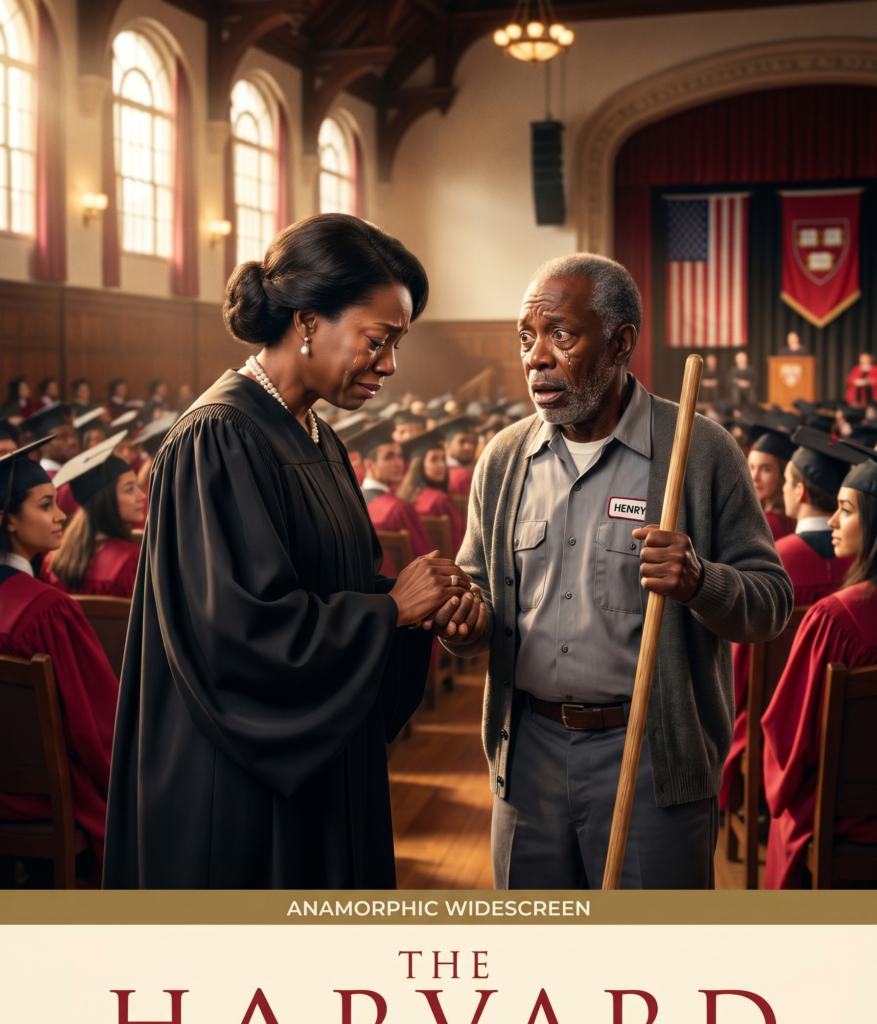
The Janitor at the Back of the Auditorium
For 32 years he cleaned their hallways. At commencement, a Supreme Court Justice walked off the stage to find him.
For thirty-two years, Henry Thompson mopped the marble hallways of Harvard Law School. He arrived at five in the morning. He left at one in the afternoon. He had cleaned the toilets used by future senators. He had wiped fingerprints off the brass railings touched by future attorneys general. The faculty called him Mr. Henry. The students rarely called him anything at all. None of them knew his last name. None of them knew he had a law degree from nineteen seventy-one. None of them knew the Supreme Court Justice giving the commencement speech that May afternoon was about to walk off the stage and change everything.
His name was Henry Thompson, and he was seventy-four years old.
He had been born in nineteen fifty-two in a small town in Alabama called Hayneville. His father had been a tenant farmer. His mother had cleaned houses for white families in Montgomery. Henry had been the first person in his family to graduate from high school, and the first person in his county, as far as anyone knew, to graduate from college.
He had attended Howard University in Washington, D.C., on a scholarship he had won by writing an essay about justice. He had graduated summa cum laude in nineteen sixty-eight. He had then attended Howard University School of Law on another scholarship, and he had graduated in nineteen seventy-one with the second highest grade point average in his class. He had passed the bar in Alabama in the fall of that year.
He had never been allowed to practice.
What They Took From Him
The story of why is long, and Henry rarely told it. But the short version is this. In November of nineteen seventy-one, two months after he passed the bar, Henry took a case representing a fifteen-year-old Black boy in Hayneville, Alabama, who had been accused of stealing a bicycle from a white storekeeper’s son. The boy was innocent. Henry proved it in court. The boy walked free.
Three nights later, six men in white hoods came to Henry’s mother’s house. They beat him in the front yard until his right leg was broken in four places. They burned a cross on the lawn. They left a note pinned to the door that said: Next time you forget your place, we will come for the rest of you.
His mother begged him to leave Alabama. He left two weeks later, walking with a cane he would use for the rest of his life. He never returned. He never tried another case. The injury to his leg was small. The injury to his belief in the law was not.
He moved north. He worked in restaurants. He drove a bus in Philadelphia for eleven years. In nineteen ninety-three, at the age of forty-one, he answered an advertisement in the Boston Globe for a maintenance position at Harvard Law School. He had laughed quietly at the irony of it. He had taken the job.
He had cleaned the floors of the building that had once rejected his application — they had told him politely in nineteen sixty-eight that they were not yet accepting students like him — for thirty-two years. He had watched generations of young lawyers walk those halls. He had said good morning to each of them. He had carried himself with the quiet dignity of a man who had decided long ago that the world would not be allowed to take more from him than it already had.
In nineteen ninety-eight, a frightened first-year student would change his life again.
The Girl in the Hallway
Her name was Maya Washington. She was twenty-three years old. She had grown up in a public housing complex in Baltimore. Her mother had cleaned office buildings at night. Maya had won a full scholarship to Harvard Law School, and she had arrived in September of nineteen ninety-eight with two suitcases, three hundred dollars, and the only suit she owned.
By November she was failing Constitutional Law.
It was not that she did not understand the material. It was that the professor, a man who had clerked for Antonin Scalia, did not believe she belonged there. He called on her three times a week to humiliate her in front of the class. He returned her papers with comments like perhaps you should consider a different field. By Thanksgiving she had stopped sleeping. By December she had stopped eating breakfast. By mid-December she was preparing to drop out.
On a Thursday night, December the seventeenth, nineteen ninety-eight, she sat alone in a third-floor hallway of Langdell Hall at eleven thirty at night, weeping into her hands. She did not see the man in the grey work shirt come out of the supply closet.
Henry Thompson stopped. He looked at the young woman crying in the empty hallway. He could have walked past. He had walked past a thousand crying students in thirty-two years. He almost did.
But something in the way she was crying — the small contained sound of a person who had decided to give up — made him stop.
He sat down on the floor across from her, his back against the wall, his bad leg stretched out in front of him.
“Young lady,” he said softly. “Whatever it is, it ain’t worth all that.”
She looked up. She did not know him. She tried to wipe her face. She said, “I’m sorry. I’m sorry, I’m just leaving.”
“You ain’t leaving,” he said. “Not tonight, not from this hallway, and not from this school.”
He did not yet know that he was right.
The Closet
She told him everything. About the professor. About the failing grade. About her mother in Baltimore who scrubbed office floors at night and called every Sunday to ask how her brilliant daughter was doing. About the loan she had taken out to cover the cost of textbooks. About the fact that she could not, would not, call her mother to say she had failed.
Henry listened. He did not interrupt. When she was done, he said, “What’s the case you got to brief by Monday?”
She blinked. She told him. Marbury v. Madison.
“Eighteen oh three,” he said. “Chief Justice John Marshall. Established judicial review. The Constitution is the supreme law of the land. Any law repugnant to the Constitution is void. You got your textbook?”
She stared at him.
“How do you…”
“Howard Law, class of seventy-one,” he said. He smiled gently. “It’s a long story. Get your textbook.”
For the next four hours, in a third-floor supply closet at Harvard Law School, a janitor walked a first-year student through the foundational case of American constitutional law. He explained Marshall’s reasoning. He challenged her arguments. He asked her questions her professor had never bothered to ask. By three thirty in the morning, she had her brief outlined. She walked back to her dorm room as the sun was beginning to rise.
She got an A on the brief.
The next Thursday night, she came back to the supply closet at eleven thirty. Henry was already there with a thermos of coffee and a folding chair he had brought from home.
For the next four years, every Thursday night, they met in that closet.
What Nobody Knew
She graduated from Harvard Law School in May of two thousand and two, third in her class. She clerked for a federal appeals court judge in Boston. She clerked for Justice Ruth Bader Ginsburg at the Supreme Court of the United States from two thousand and three to two thousand and four. She joined a civil rights firm in Washington, D.C. She argued her first Supreme Court case in two thousand and nine. She won.
She became a judge on the D.C. Circuit Court of Appeals in two thousand and seventeen.
She was nominated to the Supreme Court of the United States in twenty twenty-three. She was confirmed by the Senate in twenty twenty-four.
She had told no one — not her husband, not her clerks, not the senators who confirmed her, not the journalists who profiled her — about Henry Thompson and the supply closet.
Not because she was ashamed.
Because Henry had asked her, in May of two thousand and two on the day before she graduated, to keep it a secret.
“They don’t need to know about me,” he had said. “You earned what you earned. I just sat with you. You did the work.”
She had argued with him. He had refused.
She had visited him every December seventeenth for twenty-four years. She had brought him books. He had read every one. They had become, in the quiet language of two people who had chosen each other, family.
In April of twenty twenty-six, Harvard Law School invited her to be the commencement speaker for the class of twenty twenty-six.
She accepted under one condition. She wanted to know who would be working on the day of commencement, in the building, behind the scenes.
She wanted to know if Henry would still be there.
The dean’s office told her yes. Mr. Thompson was scheduled to clean the auditorium that morning.
She did not tell him she was coming.
May The Twenty-First
The commencement ceremony began at two in the afternoon. The auditorium held eight thousand people. The class of twenty twenty-six sat in the front sections in crimson and black robes. Their families filled the balconies. Cameras lined the back wall. C-SPAN was broadcasting live.
Henry Thompson stood at the back of the auditorium near the exit doors, just as he had stood at the back of fifteen commencements before this one. He wore his grey work shirt with HENRY stitched in white thread on the chest pocket, and a dark grey cardigan his late wife had bought him in nineteen eighty-seven. He held a wooden broom upright at his side. He was there in case anything spilled. He had never spilled a single tear at a Harvard commencement.
The dean introduced the speaker. The auditorium rose in a standing ovation. Justice Maya Washington walked to the podium in her flowing black judicial robes. She placed her notes in front of her. She thanked the dean. She thanked the class of twenty twenty-six. She began her prepared remarks about the rule of law and the meaning of public service.
Six minutes in, she stopped.
She looked down at her notes. She lifted her head. She looked past the entire auditorium to the back of the room, where a man in a grey shirt and cardigan stood quietly holding a broom.
Her eyes filled.
She stepped away from the podium. She walked down the steps of the stage. The auditorium fell silent. Eight thousand people watched her walk slowly down the center aisle in her black judicial robes. The cameras followed her. The graduates turned in their seats.
She walked to the back of the auditorium. She stopped in front of Henry Thompson. He looked behind himself as if she could not possibly be there for him. She was crying now. She took his hands.
An aide rushed forward with a handheld microphone. She took it. She turned to face the audience, still holding Henry’s hand. Her voice shook.
“Before I finish my speech,” she said, “I need to introduce you to someone.”
“His name is Henry Thompson. For thirty-two years, he has cleaned the hallways of this law school. He has a law degree from Howard University, class of nineteen seventy-one. He passed the bar in Alabama in the fall of that year. He was never allowed to practice. The reasons why are a story for another day.”
She paused. She looked at him. He was shaking his head softly. No, no, you don’t have to do this.
She squeezed his hand and continued.
“In December of nineteen ninety-eight, I sat alone in a hallway of Langdell Hall at eleven thirty at night, and I was crying because I was about to drop out of this law school. I had failed my first semester of Constitutional Law. I was twenty-three years old. I was the first person in my family to attend college. My mother cleaned office buildings to send me here. And I had decided I was not good enough.”
“Henry Thompson came out of a supply closet. He sat on the floor across from me. He said, You ain’t leaving, not tonight, not from this hallway, and not from this school. He pulled out my textbook. He walked me through Marbury v. Madison. He came back the next Thursday. And the Thursday after that. And every Thursday for four years, in a supply closet on the third floor of Langdell Hall, this man tutored me in constitutional law.”
She turned to him. The auditorium was utterly silent. Eight thousand people leaned forward as one.
“Without this man,” she said, “I would have dropped out my first year. I would not have clerked for Justice Ginsburg. I would not have argued before the Supreme Court. I would not have been confirmed to the Supreme Court. And the world would have one fewer justice.”
She paused. She lifted his hand and pressed it against her cheek.
“Mr. Thompson,” she said quietly, “I think it is time the world knew your name.”
What Happened Next
The auditorium rose to its feet.
It was not the polite standing ovation of a commencement ceremony. It was a sustained, full-throated, weeping ovation that lasted eleven minutes. Graduates were sobbing into their hands. Faculty members in their academic regalia stood and cried. Henry Thompson stood at the back of the auditorium in his grey work shirt, holding a Supreme Court Justice’s hand, looking at eight thousand strangers who were standing for him.
He did not know what to do. He had not stood in front of a courtroom in fifty-five years. He had not been seen by this many people, ever, in his life.
Justice Washington lifted the microphone to his mouth.
“Sir,” she said softly, “they want to hear from you.”
He looked at her. He looked at the crowd. He cleared his throat. He spoke for the first time, into a microphone, on national television, at the age of seventy-four.
“I just sat with her,” he said. “She did the work.”
The auditorium rose into a second, longer ovation.
By the time the ceremony ended, the video of the moment had been shared three million times. By midnight, fifteen million. By morning, Harvard Law School announced the establishment of the Henry Thompson Scholarship, a full-tuition, four-year scholarship for first-generation Black students from the South. By the end of the week, six other law schools had announced similar scholarships in his name.
Henry retired the following Monday. He had wanted to finish out the year, but the dean would not allow it. They held a ceremony in his honor. Maya Washington flew up from Washington to attend. She brought him a gift — a leather-bound copy of the Constitution of the United States. Inside the front cover she had written:
For Henry Thompson. The finest lawyer who never got to argue. You taught me everything. — Maya, December 17, 1998 to forever.
He bought a small house in a quiet neighborhood in Cambridge, paid for by a fund that had been quietly organized in his name. He spent his mornings reading. He spent his afternoons walking, his bad leg supported by the same cane he had used since he was twenty.
He gave one interview, to a young Black journalism student from Howard who had written him a careful letter. She asked him how it felt to finally be recognized. He thought about the question for a long time. Then he said:
“I wasn’t ever invisible, child. I just wasn’t looking to be seen. The work was the work. And the girl was always going to be a justice. I just sat with her on the night she forgot.”
The journalist asked him if he had any regrets.
He smiled.
“I have one,” he said. “I should have told my mama, before she passed, that the world would one day be alright. She died thinking she had failed me. But everything I am, I am because of her. The law school just gave me a place to do the work.”
He paused. He looked out the window of his small house in Cambridge.
“Tell your mama you love her tonight, child. The world is full of janitors. Most of them are mothers.”
Continue Reading
More stories you’ll love
The Coffee Lady
For 30 years they laughed at her cheap shoes. They never noticed the notebook in her purse…
The Name She Never Used
She buried it for sixty-two years. Then a ten-year-old girl handed her an envelope at brunch…
The Cleaning Lady at Table 12
For 22 years she scrubbed their floors. The night they gave her a retirement gift, she gave them back forty-four years of silence…