
The Cleaning Lady at Table 12
For 22 years she scrubbed their floors. The night they gave her a retirement gift, she gave them back forty-four years of silence.
For twenty-two years, Esther Mae Williams arrived at Cassano’s Restaurant at exactly five in the morning. She left at nine, before the chefs walked through the back door. In all those years, she never once sat at a table. She never once tasted the food. She never once spoke to the owner. They called her the cleaning lady. They never asked her name. They were about to learn it.
Her name was Esther.
She was sixty-eight years old, born in Greenwood, Mississippi, in nineteen fifty-eight. She had three sisters who were gone now, a mother buried in red Delta clay, and a small one-bedroom apartment in the Bronx with a kitchen window that faced an airshaft. She made her coffee black. She read her Bible at night. She wore a gold wedding band on her left hand that she had not removed in forty-four years.
Nobody at Cassano’s knew about the ring. The uniform sleeves were always long enough to hide it. And nobody ever looked at her hands.
The Restaurant
Cassano’s was the kind of restaurant where a glass of wine cost more than Esther’s daily wage. It sat on East Sixty-Third Street between Madison and Park, behind a heavy oak door and a discreet brass plaque. Senators ate there. Heiresses celebrated their engagements there. A famous actress once cried at table fourteen after her divorce, and the manager comped her tiramisu.
The current owner was Marco Cassano Jr. He was forty-two, recently divorced, sharp as a knife, and had inherited the restaurant from his father in two thousand and fourteen. He had been raised on the Upper East Side, schooled at Choate, and educated at Yale. He spoke three languages. He believed himself to be a good man.
In the twelve years since taking over, he had never once spoken to Esther.
It was not malice. It was simpler than that. She arrived before he was awake, and she left before he came in. He saw her sometimes in the hallway by the staff lockers, mop in hand, head down. He nodded. She nodded back. That was the extent of their relationship.
He didn’t know that she had been cleaning his father’s restaurant since nineteen ninety-four. He didn’t know that she had watched his father die slowly between two thousand and seven and two thousand and nine. He didn’t know that the night his father passed, Esther had cleaned the restaurant alone until four in the morning, weeping quietly into a bucket of warm water.
He didn’t know any of it. And neither did anyone else.
What Came Before
To understand what happened at table twelve on the night of May the twentieth, you have to go back to nineteen seventy-eight.
Esther was twenty years old. She had come north from Mississippi the year before, carrying one suitcase and the address of a cousin in Brooklyn. She worked the night shift at a hospital, cleaning operating rooms. She walked home through quiet streets at sunrise.
She met Marco Cassano Senior at a diner on Lexington Avenue at two in the morning. He was a line cook then, twenty-four years old, with flour on his apron and a tired smile. He bought her coffee. She let him. He came back the next night. And the next.
They were married eight months later in a small chapel in Atlantic City. There were two witnesses — a hotel clerk and a tired-looking judge. They could not afford rings, so Marco gave her a thin gold band his grandmother had left him. He kissed her on the forehead and told her he would buy her a real one when the restaurant opened.
They lived in a one-room apartment above a laundromat in Queens for almost three years. They ate spaghetti with butter and salt. They saved every dollar. Marco talked about opening his own place. Esther talked about having children. They were poor and they were happy.
Then his family found out.
What His Family Did
The Cassanos were old-money Italian American, four generations deep in restaurants and real estate. They had a brownstone in Carroll Gardens and a house in Sicily. When they discovered that Marco had married a Black woman from Mississippi in a secret ceremony, they did not yell. They did not weep. They did something much worse.
They sat their son down at a Sunday dinner in the spring of nineteen eighty-one and gave him a choice. Stay with the girl, and lose the family. Lose the investment they had been quietly preparing for him — a restaurant on East Sixty-Third Street. Lose the trust fund his grandfather had left him. Lose his mother. Lose his name.
Or sign the papers they had brought with them. Annul the marriage. Pay Esther a settlement. Sign a confidentiality agreement. Walk away.
Marco signed the papers.
He came home that night and could not look her in the eye. He left an envelope on the kitchen table with three thousand dollars in cash and a note that said only, “I am so sorry. I am not strong enough. Forgive me if you can.”
Esther was six months pregnant.
What She Lost
She lost the baby eleven days later.
She would not speak about that week for the rest of her life, not to her sisters, not to her cousin, not to the kind doctor at the public hospital who held her hand. She would carry it the way some people carry an old photograph in their wallet — folded small, soft at the edges, the picture barely visible from how many times it had been touched.
She did not cash the three thousand dollars. She kept the envelope in a drawer beside her bed for twenty-eight years, and when she finally needed the money — when her mother was sick and the hospital bills came — she opened it slowly, with shaking hands, and used it. She kept the note. She still had it. It was tucked inside an old Bible on her shelf.
She did not remarry. She did not date. She did not have other children.
In nineteen ninety-four, when she was thirty-six years old and the loneliness had become a kind of furniture in her life, she walked past the brass plaque of Cassano’s on East Sixty-Third Street. She stood across the street for a long time, looking at the windows. Then she went inside and asked if they were hiring.
The night manager told her they needed someone to clean before the shift started. Five to nine in the morning. Ten dollars an hour. She said yes before he finished the sentence.
She did not do it for revenge. She did not do it to confront him.
She did it because she wanted, just once, to see the life she should have had.
Twenty-Two Years
For twenty-two years she cleaned the floors of the restaurant Marco’s family had built him.
She mopped the marble entryway where his second wife had once stood in a white fur coat. She polished the brass railings of the staircase. She wiped down table seven, where Marco proposed to that second wife in nineteen eighty-six. She emptied the wastebasket in the office where his son was conceived. She cleaned the bathroom mirrors where Marco had once washed flour from his hands at two in the morning in nineteen seventy-eight, on the night he first told her he loved her.
She watched the seasons turn through the front window. She watched Marco grow older. She watched his hair turn white. She watched him laugh with his son in the dining room on Sunday mornings before the restaurant opened.
She watched him get sick.
In two thousand and eight she found him slumped at table twelve at six in the morning, alone, weeping into his hands. He did not see her. He did not hear her. She stood in the doorway of the kitchen with a tray of clean glasses, and she watched him cry. Then she set the tray down quietly and walked away, because she could not bear to be seen.
She did not know what he was crying about. She found out later.
He had been writing her a letter.
The Letter
In April of two thousand and nine, three months before Marco Cassano Senior died of pancreatic cancer at the age of fifty-five, he wrote a letter. He addressed it to a woman named Esther Williams, last known address in the Bronx. He did not have the courage to send it.
When he died, the letter was found in his desk drawer, sealed. His son was twenty-five years old at the time. He found it while sorting through his father’s papers. He read it once, did not understand it, and put it back in the drawer. Twelve years passed. He forgot about it.
In the spring of two thousand and twenty-six, Marco Cassano Junior decided to sell the restaurant.
It was time, he told himself. He was forty-two, recently divorced, and the work was killing him. New owners would take over in June. He wanted to thank his staff before they left. He wanted to give them something. He wanted to be a good man.
He went through the old files looking for the names of every employee who had worked at Cassano’s for more than ten years. He made a list of fifteen people. He prepared envelopes for each one. Inside each envelope was a personal check and a card.
At the top of the list was a name he had to look up: Esther Mae Williams. Hired in nineteen ninety-four. Twenty-two years of service. Position: cleaning staff.
He had no idea who she was.
The Night
The thank-you dinner was held on a Tuesday in May. The restaurant closed early. Fifteen employees gathered around the long table at the back. Marco poured wine. He gave a small speech. He thanked them one by one, handing each of them an envelope.
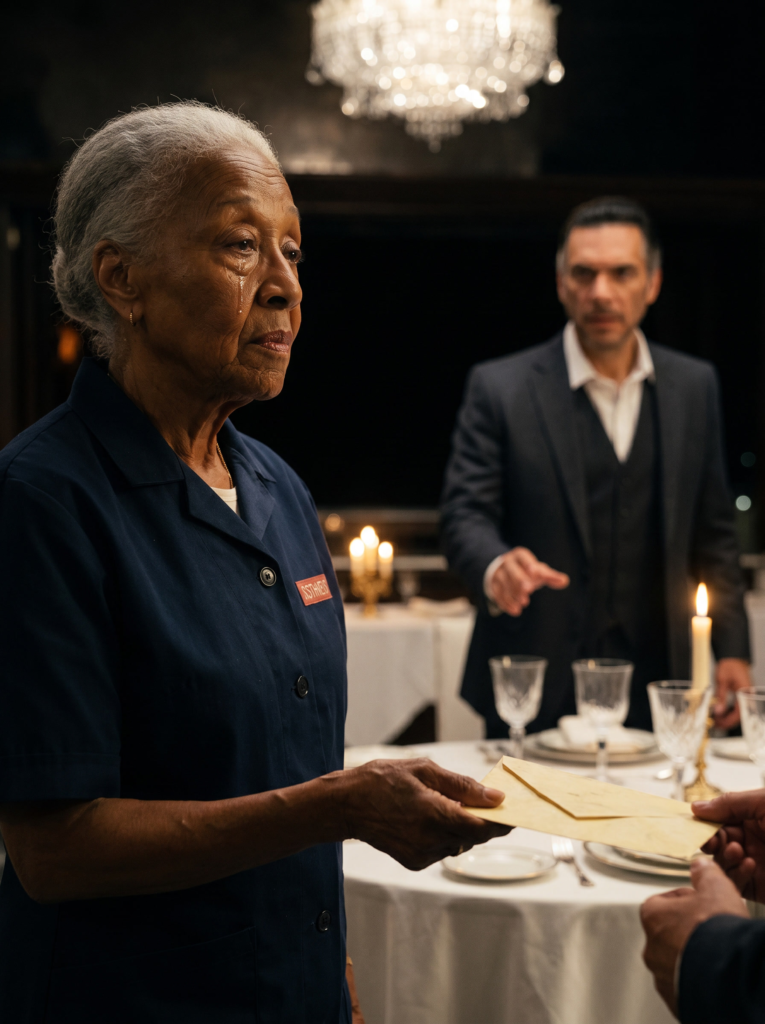
Esther sat at table twelve. She wore her cleaning uniform because she did not own anything else nice enough. Her hair was pulled back in a low neat bun. Her hands were folded in her lap.
When Marco came to her, he smiled politely. He did not know her face. He looked at the name on the envelope and then back at her.
“Esther,” he said. “Twenty-two years. Thank you for everything.”
He held out the envelope.
She took it with both hands. She did not open it. She set it gently on the white tablecloth. The candle flickered. The other staff watched.
Then she reached into the pocket of her uniform and pulled out a different envelope. It was yellowed with age. The edges were soft from forty-four years of being touched.
She slid it across the table toward him.
“I’ve been holding this one a long time, Marco,” she said. “Forty-four years.”
He looked at her. He looked at the envelope. He looked at her again. Something moved in his face. The smile faded. His hand reached out slowly, almost against his will, and he picked up the envelope and opened it.
Inside were three things.
A marriage certificate dated October seventeenth, nineteen seventy-eight, between Marco Anthony Cassano and Esther Mae Williams.
A photograph of a young Black woman, six months pregnant, standing in a small kitchen above a laundromat in Queens.
And a handwritten letter, sealed and unopened, addressed to Esther Williams, in his father’s handwriting.
What He Read
Marco Junior’s hands began to shake. He looked up at her. She was watching him quietly. Her face was very still.
“Open it,” she said softly. “It was always for you, too.”
He opened his father’s letter. The other staff had gone quiet now. They sensed something was happening that they did not understand.
The letter was three pages long. It told the story of a young man and a young woman who had loved each other in nineteen seventy-eight. It told the story of a family that had threatened him with everything he had. It told the story of an envelope of cash left on a kitchen table, a baby that did not survive, and a silence that had lasted thirty years. It ended with the words: I am dying now. I do not deserve forgiveness. But if there is any kindness left in the world, I hope this letter finds you, and I hope someday it finds my son. Tell him I am sorry I was not brave. Tell him to be braver than I was.
Marco Junior read it twice. Then he put it down. He looked at Esther across the table. His face had gone white.
“You’re…” he said. He could not finish the sentence.
“I was your daddy’s first wife,” she said gently. “A long time before your mother. I was twenty years old, and he was twenty-four, and we loved each other very much. I lost the baby. I never had another. And then I came here in nineteen ninety-four because I needed work, and because I wanted, just once in my life, to see what he had built without me.”
She paused. Her eyes were wet but her voice did not shake.
“I am not here to take anything from you, Marco. I am not here for the restaurant. I am not here for money. I am here because your daddy wrote that letter and never had the courage to send it, and you deserve to know who your father really was. And you deserve to know that I forgave him a long, long time ago.”
She stood up slowly. She left the cream envelope from Marco unopened on the table. She picked up her purse.
“Thank you for twenty-two years of work, Marco Junior. I am going to retire now. You take good care of yourself.”
She walked out of Cassano’s for the last time.
The other staff sat in silence. Marco Junior sat at table twelve with three pieces of paper in front of him and a candle burning between them. He did not move for a very long time.
The Morning After
At five o’clock the next morning, Esther was making coffee in her small kitchen in the Bronx when there was a knock at her door.
She opened it.
Marco Junior stood in the hallway in the same charcoal suit he had been wearing the night before. He had not slept. His eyes were red. He held his father’s letter in his hand.
“Ma’am,” he said. His voice broke a little. “I was hoping I could have a cup of coffee with you.”
She looked at him for a long moment. Then she smiled, very softly, and stepped aside to let him in.
She poured him a cup of black coffee. She sat across from him at the small kitchen table. The light from the airshaft was grey and cold.
He said, “My father wrote in that letter that he wished he had been braver. I want to be braver than he was.”
She nodded. She reached across the table and put her hand over his. Her gold wedding band caught the morning light.
“You can call me Esther,” she said.
He nodded. He could not speak. He drank his coffee. They sat together for a long time without saying anything else.
Outside, the city was just beginning to wake.
Continue Reading
More stories you’ll love
The Coffee Lady
For 30 years they laughed at her cheap shoes. They never noticed the notebook in her purse…
Read Story →The Name She Never Used
She buried it for sixty-two years. Then a ten-year-old girl handed her an envelope at brunch.
Read Story →She Disappeared on Their Wedding Day
Everyone said she got cold feet. Years later a letter arrived…
Read Story →