
The Name She Never Used
She buried it for sixty-two years. Then a ten-year-old girl handed her an envelope at brunch.
For sixty-two years, the most carefully guarded secret in Margaret Whitfield’s life was her own name. The morning a ten-year-old girl walked into the brunch room of the Brookhaven Country Club and placed a yellowed envelope on her tablecloth, the secret began to die.
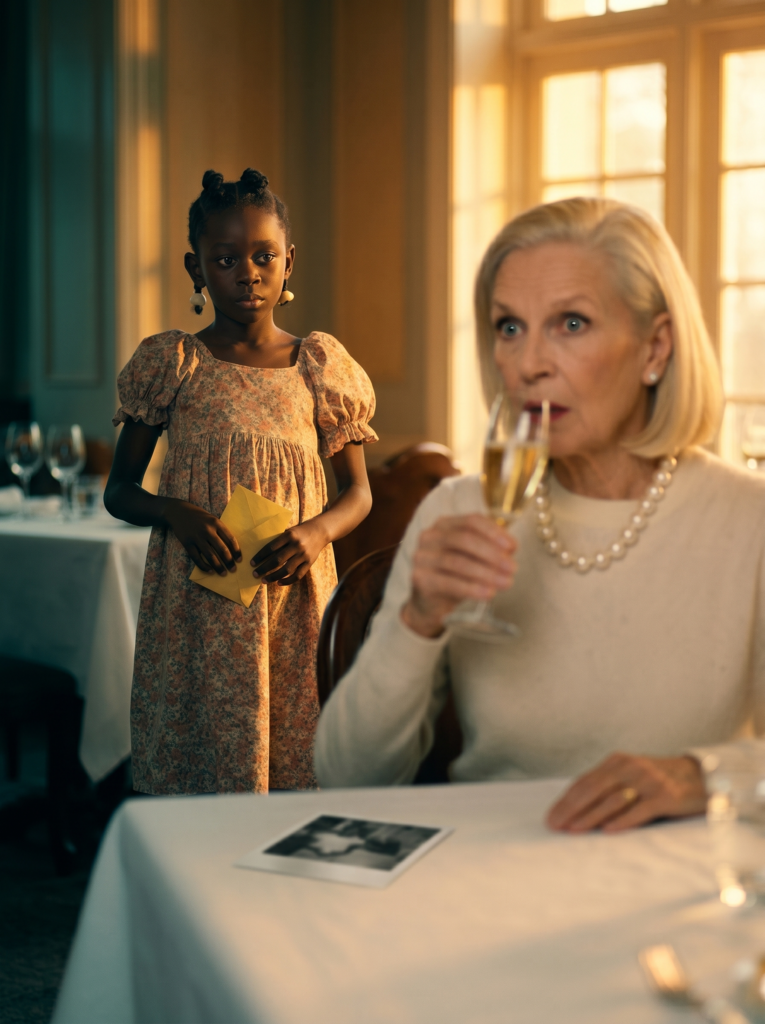
It was a Sunday in late April. The kind of Sunday where the light in the country club’s east dining room came through the tall windows in long warm sheets, making the silverware look gold and the champagne look like honey. Margaret was sitting at her usual table — round, four-top, by the second window from the patio — with her two oldest friends, Patricia Hollis and Eleanor Vance.
They were laughing at something Patricia had said about her grandson’s tennis coach. Margaret was holding her flute halfway to her mouth, the bubbles still rising, when she noticed the room had grown a little quieter.
She looked up.
A small Black girl was standing beside her chair.
The Girl in the Floral Dress
The girl was about ten years old. She wore a hand-me-down floral cotton dress that was a touch too small for her, white socks pulled neatly up to mid-calf, and black shoes that had been polished but could not hide their years. Her hair was braided into two neat plaits with small white beads at the ends. She held an envelope in both of her hands the way you might hold a bird you didn’t want to crush.
Margaret blinked at her, then looked toward the maître d’ across the room, expecting him to come over and quietly handle the situation. He was not looking at the table. He was looking at the girl. So was the bartender. So, Margaret slowly realized, was most of the dining room.
The girl waited until Margaret’s eyes returned to her.
“Are you Margaret Whitfield?” she said. Her voice was quiet and clear, the way a school recital is quiet and clear — practiced, careful, with the small tremor of a child who has rehearsed something for a long time.
“I am,” Margaret said. She set down her champagne. “Sweetheart, are you lost? Where’s your mother?”
The girl did not answer the second question. She placed the envelope on the white tablecloth, next to Margaret’s bread plate, and slid it gently forward.
“My great-grandmother asked me to give you this,” she said. “She made me promise. She said you would know what it means.”
The Envelope
The envelope was yellowed at the corners. The flap was glued shut with the kind of brittle wax-paper tape that hasn’t been manufactured in fifty years. Margaret’s name was written across the front in a careful, looping handwriting she had not seen in more than six decades, but recognized instantly the way a person recognizes the sound of their own mother’s voice in a crowded room.
“Maybelle Lillian Carter,” the envelope said.
Not Margaret Whitfield.
Margaret’s hand stopped halfway to the table.
Patricia, who had been about to say something, frowned. “Margaret? Is everything all right?”
Margaret did not answer. She picked up the envelope. The girl watched her with the patient steadiness of a child who had been told, over and over, not to leave until the woman opened it.
Margaret slid a thumbnail under the flap. The brittle tape gave with a small dry crack. Inside the envelope was a single black-and-white photograph and a folded slip of paper.
She looked at the photograph first.
The Photograph
It was a picture of two little girls standing on a porch.
The porch was painted white. The wood was warped. There was a screen door behind them with a tear in the corner. Both girls looked about ten years old. They wore matching cotton dresses, hand-sewn, with tiny floral prints. Both girls were Black.
On the back of the photograph, in pencil, in the same careful looping handwriting from the envelope, someone had written:
Maybelle and Esther, June 1962. Pine Ridge, Alabama.
Margaret’s hand began to shake.
Eleanor, who had been quietly watching her face, leaned forward. “Margaret, darling, what is it? You’ve gone completely pale.”
Margaret did not speak. She unfolded the slip of paper. It was short. Just three sentences in the same handwriting, but shakier — the handwriting of a very old woman in the last weeks of her life.
I never blamed you for leaving, Maybelle. I just wanted you to know I never stopped looking for you. The girl who hands this to you is your great-granddaughter, and her name is Esther — the same as mine was.
Margaret set the paper down very slowly.
She looked up at the girl.
“Esther,” she said. The word came out broken.
The girl nodded once. “She passed three weeks ago, ma’am. She told me you’d know who she was. She told me to wait until you opened it. That’s all.”
What Margaret Knew
She knew. Of course she knew. She had known every morning of her life for sixty-two years.
She had grown up in Pine Ridge, Alabama, in a four-room house at the end of a red-dirt road. Her name had been Maybelle Lillian Carter. She had been the daughter of a sharecropper and a laundress. She had a sister named Esther, two years younger, who used to sneak into her bed at night when there was thunder.
When Margaret — when Maybelle — was seventeen years old, her skin was light enough and her hair was straight enough and her bone structure was fine enough that her mother sat her down at the kitchen table one August evening in 1964 and said, in a voice that allowed no argument: Baby, you can pass. Up north. You can get out of here. You can have a life none of us will ever have. But if you go, you can’t come back. Not ever. Not even to see me.
Maybelle had cried for three days. Then she had taken the bus to Chicago. She had worked as a secretary at an insurance firm. She had met a young white law student named Richard Whitfield in the elevator. She had been so careful — so terrified — that she’d told him her parents had died in a fire when she was a child. That she had no family. That there was no one left to invite to the wedding.
He had believed her. Of course he had. Why would he not?
She had become Margaret. She had moved to New York. She had given Richard three sons and a life in a Park Avenue townhouse and a summer house in East Hampton. She had attended the Whitfield family Thanksgivings for fifty-eight years and answered every question about her childhood with the same small story about an orphanage in Kentucky and a kind nun named Sister Agnes.
Richard had died in 2017. Her sons did not know. Her grandchildren did not know. Her best friends Patricia and Eleanor, who were now staring at her in confused silence — they did not know.
No one had ever known.
No one except Esther. Her little sister. Who had crawled into her bed during thunderstorms. Who she had left behind on a porch in Alabama in 1964 and never written to. Not once. In sixty-two years.
Esther, who had apparently spent every one of those years quietly looking for her.
The Question
Margaret looked at the little girl. The girl looked back at her with eyes Margaret recognized, eyes she had not seen in six decades, eyes that had belonged to her sister at exactly the same age.
“How did she find me?” Margaret whispered.
The girl shrugged the small shrug of a child who is repeating something she has been told. “She said the church bus had a picture of you in the paper last year. The fundraiser. She said she’d recognize your face anywhere, even if you’d changed your name. She said you have a mark above your left eyebrow shaped like a comma.”
Margaret’s hand went unconsciously to her left eyebrow.
The scar from when she fell off the porch chasing Esther in 1959 was still there. It had faded over the years to a thin white line. She had told Richard, on their first date, that it was from a bicycle accident.
“Where do you live now?” Margaret said.
“Birmingham, ma’am. With my mom. My grandma. She raised me after my mama got sick.”
“And your great-grandmother — Esther — she raised your grandmother?”
The girl nodded.
“And what was your great-grandmother’s last name? When she died?”
The girl said it quietly.
“Carter, ma’am. Esther Lillian Carter. Same as yours used to be.”
The Choice
Patricia leaned across the table, her face creased with the kind of concern that white women of her age put on like a coat. “Margaret, sweetheart, what on Earth is this child talking about? Should I get the manager?”
It was the moment Margaret had spent sixty-two years preparing for. It was also the moment she had spent sixty-two years praying would never come.
She had imagined it a thousand times. A reporter, maybe. A DNA test someone insisted she take. A cousin from Alabama who had tracked her down and walked into her townhouse demanding money. She had imagined every version of it. She had imagined herself denying everything. She had imagined herself paying someone off. She had imagined herself, in her worst moments, simply pretending not to understand.
She had never imagined a ten-year-old girl in a hand-me-down floral dress with two beaded braids and her own dead mother’s eyes.
Margaret looked at the photograph on the tablecloth.
Two little girls on a porch in Pine Ridge, Alabama, in June of 1962. One of them was the woman she had built her whole life pretending not to be. The other was the sister she had left behind on a porch and never written to in sixty-two years.
She thought about Patricia and Eleanor. She thought about her three sons. She thought about her grandchildren, who had never asked too many questions because she had taught them, gently, not to. She thought about Richard, who had loved her for fifty-three years and had been buried next to the great-grandfather of the girl standing in front of her — though he would never have known it.
She thought about her mother, who had died alone in Pine Ridge in 1971, who Maybelle had never returned to bury, because returning meant being seen.
She thought about her sister Esther, who had quietly raised a daughter and a granddaughter and now a great-granddaughter, all named for her, all looking for the sister who had vanished in 1964.
Margaret reached across the table and took the little girl’s hand.
She held it the way she had not allowed herself to hold anyone in sixty-two years.
Then she looked at Patricia, and at Eleanor, and at the entire warm sunlit dining room of the Brookhaven Country Club, and she said the sentence that ended one life and began another.
“My name is Maybelle Lillian Carter. And this is my great-niece. And I would like to take her home.”
What Happened After
Patricia did not understand. Patricia would not understand for several weeks, and even then only partially. Eleanor stopped speaking to her within the month. The Whitfield family lawyer called twice in the following week, then stopped calling.
Margaret — Maybelle — drove the little girl back to Birmingham the following Tuesday. She met her great-niece’s mother for the first time in a small kitchen at the back of a small house at the end of a quiet street. The mother cried. Maybelle cried. The little girl sat between them on the linoleum floor and held both their hands at once.
Her three sons reacted differently. Her oldest, the lawyer, refused to speak to her for almost a year. Her middle son cried on the phone for forty minutes and then asked if he could fly down to Birmingham to meet his cousins. Her youngest, who had always been the gentlest of the three, asked her a single question.
“Mom — were you happy? In the life you built? Or was every day exhausting?”
She told him the truth.
She told him both things had been true at the same time, for sixty-two years.
The Last Thing
Maybelle is seventy-eight years old now. She lives in a small house three blocks from her great-niece in Birmingham, Alabama. She has a porch. She painted it white. She sits on it most mornings with a cup of coffee and watches the kids walk to school.
The photograph from the envelope is framed on her kitchen wall.
Two little girls in matching cotton dresses, standing on a porch in Pine Ridge, Alabama, in June of 1962.
Her sister Esther’s grave is in the cemetery off Highway 78, the one with the dogwood trees. Maybelle visits every Sunday. She brings flowers. She talks to her for a long time. She always ends with the same sentence.
“I came home. I’m sorry it took me sixty-two years. I came home.”
The little girl who delivered the envelope is twelve now. She wants to be a writer. She is sitting in her great-aunt Maybelle’s kitchen right now, working on a story for her seventh-grade English class.
The story is called The Name She Never Used.
It is the only family history she will ever need to know.
Continue Reading
More stories you’ll love
The Coffee Lady
For 30 years they laughed at her cheap shoes. They never noticed the notebook in her purse…
Read Story →The Cleaning Lady at Table 12
For 22 years she scrubbed their floors. The night they gave her a retirement gift, she gave them back forty-four years of silence.
Read Story →She Disappeared on Their Wedding Day
Everyone said she got cold feet. Years later a letter arrived…
Read Story →