
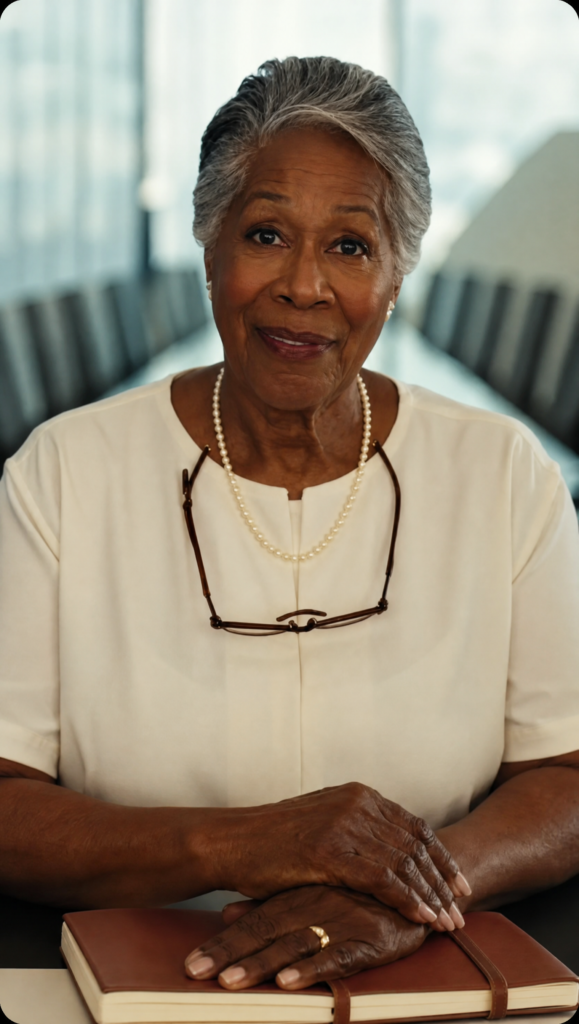
The Coffee Lady
For 30 years they laughed at her cheap shoes. They never noticed the notebook in her purse.
For thirty years, they called her the coffee lady. They never called her by her name. They never asked about her children. They never noticed the worn leather notebook in her purse. They were about to learn that this was the most expensive mistake of their lives.
Her name is Margaret Davis.
Thirty years ago, she walked into the marble lobby of Whitmore & Stone Capital with forty dollars in her purse, two children at home, and a single line on her résumé that read fast typist, willing to learn. She was thirty-two years old. Her husband had been gone six months. Her electricity was three days from being cut.
The hiring manager, a man named Donald who would later be fired for sexual harassment in 2007, looked her over the way men of that generation looked over women like Margaret. He hired her at the lowest secretary rate the firm offered.
“Pour the coffee,” he said. “Take the notes. Smile. And don’t speak unless you’re spoken to.”
She nodded. She said thank you. She walked out of the building and threw up in the alley behind the bagel shop on 47th Street. Then she went home, made macaroni for her son and daughter, and showed up the next morning at six forty-five.
The Invisible Woman
There is a particular kind of invisibility that comes with being a quiet woman of color in a Wall Street boardroom in 1995. You become furniture. You become the hand that refills the carafe. You become a sound — the soft clink of porcelain against a saucer — and nothing more.
Margaret learned this in her first month. She also learned something else.
When you are furniture, people speak in front of you the way they speak when they think they are alone.
She heard the first secret on a Tuesday in October. Two senior partners, talking over her head while she poured Colombian roast into bone-white cups, discussed how to “lose” a quarterly filing that would have exposed an eight-figure accounting irregularity. They laughed about it. One of them, a man named Richard, said the SEC investigator they’d just had lunch with was easier to handle than his mother-in-law.
Margaret poured the second cup. She smiled politely. She walked back to her desk on the thirty-fourth floor. And in the bottom right-hand drawer, beneath a stack of yellow legal pads, she pulled out a small brown leather notebook her daughter had given her for her thirty-second birthday.
She wrote down the date.
She wrote down the names.
She wrote down every word.
Thirty Years of Notes
The notebook came with her everywhere. To board meetings. To client lunches. To the small private dining room on the forty-second floor where the men who ran Whitmore & Stone Capital made the decisions that moved billions of dollars and ruined thousands of lives.
She watched three CEOs come and go. She watched young, hungry executives become tired, divorced men. She watched the company swell from a five-million-dollar boutique firm into a four-billion-dollar empire with offices in Hong Kong, Dubai, and London.
And every single day, she heard things.
She heard them mock the cleaning ladies who came at six in the evening. She heard them laugh at her shoes — the same pair of black leather flats she’d polished and re-polished for nine years because she was paying off her son’s college tuition. She heard them call her the old Black lady on thirty-four when they thought she was in the bathroom.
But she also heard the rest.
She heard about the illegal merger of 2003 — the one where two competing banks were quietly told what each other’s bid would be. She heard about the insider trade on the pharmaceutical company in 2008, three days before the FDA announcement. She heard the exact dollar figure of the harassment settlement paid to a twenty-four-year-old analyst in 2011, and she heard the senior partner laugh about it the next morning over croissants.
She heard about the senator in 2014 who took the “consulting fee.” She heard about the Manhattan apartment on East 63rd where a mistress was kept by a man whose wife had just been diagnosed with cancer. She heard the accountants in 2019 being told, in plain language, to “lose” three boxes of paperwork before the auditors arrived.
Every meeting. Every secret. Every lie.
She wrote it all down.
Three hundred and forty-one pages, by the end. Cross-referenced. Dated. Initialed. Some entries followed by the words verified or confirmed by D.S. on the following Monday. She had a system. She had thirty years.
And she had a plan.
The Retirement Party
On a Friday morning in late October, the firm threw Margaret a retirement party in the main boardroom on the forty-second floor.
They did not throw her a party because they respected her. They threw her a party because HR had recently sent a firm-wide memo about “celebrating diverse employees” and because Margaret’s thirty-year tenure made for a useful LinkedIn post.
Three young vice presidents stood at the front of the room. Brad, twenty-nine, the son of a managing director. Tyler, thirty-one, who had been promoted twice in two years for reasons no one could name. Connor, twenty-eight, who had once asked Margaret if she could “make her coffee taste less like a diner.”
They raised their champagne glasses.
“Thirty years of bringing us coffee, Margaret!” Brad called, to laughter from the back of the room.
“What a CAREER!” Tyler said, lifting his glass higher.
Connor was smiling the kind of smile a man only smiles when he believes he will never be punished for anything.
“We’ll miss the only thing you were good at, sweetheart.”
The room laughed. Not all of it. But enough of it.
Margaret sat at the long mahogany table. She wore the same cream-colored blouse she had worn on her first day, the one her daughter had ironed for her thirty years ago. She wore a double strand of pearls that had been her mother’s. She wore the same black leather flats.
On the table in front of her, resting against her folded hands, was the worn brown leather notebook.
They didn’t notice it.
They didn’t notice that she wasn’t smiling.
They didn’t notice that the calm woman across the table was about to end them all.
Three Sentences
Margaret stood up.
The laughter softened, then stopped. There was something about the way she rose — slow, deliberate, the way a judge rises before delivering a sentence — that made every person in the room go quiet.
She raised the notebook.
She did not raise her voice.
She said three sentences that those three men will hear in their nightmares for the rest of their natural lives.
“For thirty years, I brought you coffee. For thirty years, I heard every secret. For thirty years, I wrote everything down.”
She slid the notebook across the table.
It came to a perfect, gentle stop in front of Brad.
He looked down at it. He looked up at her. His champagne flute was still raised, frozen halfway between the table and his mouth, the bubbles catching the boardroom light.
Margaret smiled. Not unkindly. Just calmly. The way you smile at a child who has just lost a game they didn’t know they were playing.
“And the journalist from the Wall Street Journal,” she said, “is waiting outside.”
What Happened Next
The boardroom emptied in less than four minutes.
Brad was the first to leave. He didn’t take the notebook with him. He left his champagne flute on the table, half-full, the bubbles still rising. Tyler called his lawyer from the hallway, loud enough that everyone heard him say the words attorney-client privilege three times before the elevator doors closed. Connor stayed the longest. He stared at Margaret across the empty table for almost a full minute. Then he picked up the notebook with shaking hands, opened it to a random page, read three lines, and dropped it like it was on fire.
Margaret picked it up calmly. She slid it into her purse. She walked out of the boardroom, past the receptionist who had never once said good morning to her, and down to the lobby.
The journalist was waiting in a black coat by the security desk. Her name was Elena Vasquez. She had been investigating Whitmore & Stone Capital for two years. Margaret had reached out to her four months ago through a junior reporter who used to be her son’s college roommate.
In the lobby, Margaret handed Elena a photocopy. Not the notebook itself — the notebook was her insurance policy. A complete copy. Three hundred and forty-one pages, scanned and bound at a Staples in Queens the night before.
“Page two hundred and seventeen,” Margaret said quietly. “That’s where you’ll want to start.”
Elena nodded. She didn’t smile. She understood.
Margaret walked out into the cold October air. She did not look back.
The Front Page
The Wall Street Journal ran the first article forty-eight hours later. It was three thousand words long. It named seven senior executives. It cited fourteen specific dates, eleven dollar amounts, and three sitting United States senators.
The second article ran the following Tuesday. By Friday, the FBI had executed a search warrant on the firm’s Manhattan headquarters. By the following Wednesday, the stock had lost sixty-three percent of its value. By the end of the month, Whitmore & Stone Capital — a four-billion-dollar empire built over four decades — had filed for Chapter 11 bankruptcy.
Brad pled guilty to securities fraud and was sentenced to seven years. Tyler is currently awaiting trial on four counts. Connor cooperated with prosecutors in exchange for a reduced sentence and is expected to serve eighteen months at a minimum-security facility in Pennsylvania.
Margaret’s name appeared in the Journal’s coverage exactly once. A single line, near the bottom of the third article. It identified her as a longtime administrative employee who declined to comment.
She never gave an interview. She never did a podcast. She never wrote a book.
The Last Page
Two weeks after the bankruptcy filing, Margaret was sitting in her kitchen in Queens, drinking coffee from a chipped mug her granddaughter had made in second-grade art class. The kettle was on. The morning sun was coming through the window over the sink the way it always did.
Her son David sat across from her. He was forty-one years old. He had her mother’s eyes. He worked as a high school teacher in the Bronx and made forty-eight thousand dollars a year and was, by every measure that mattered to Margaret, the best thing she had ever made.
She slid the notebook across the table.
“There’s one entry I didn’t give the journalist,” she said. “I need you to read it. And then I need you to decide what we do with it.”
David looked at her. He opened the notebook to the page she had marked with a single red ribbon. It was page two hundred and seventeen.
The entry was dated November 14th, 1996. It was about a young intern at the firm — the son of the founder, twenty-two years old, on track to inherit the entire company. The entry described how this young man had paid for a “discreet relocation” of a woman who had become pregnant by him that summer. The woman was a custodial worker on the thirty-fourth floor. She was unmarried. She was Black. She was, the entry noted in Margaret’s careful handwriting, my sister Diane.
David read it twice. He looked up at his mother.
“Aunt Diane,” he said quietly.
Margaret nodded once.
“She died in the move,” she said. “Eight months pregnant. The car accident on Route 9 in October. You were born in the hospital two hours before she stopped breathing. I told everyone you were mine. I had just had my daughter. My milk hadn’t come in yet. No one asked questions.”
David was very still.
“And my father,” he said. Not a question.
“Daniel Whitmore,” Margaret said. “He died of a heart attack in 2009. He never knew you existed. I made sure of that. Because he was the kind of man who would have erased you the way he erased your mother.”
She reached across the table and put her hand on the notebook.
“You were the heir to four billion dollars, David. And I burned it all down before they could find out you existed.”
David sat in his mother’s kitchen for a long time. The kettle whistled. Neither of them moved.
Finally, he reached out, and he closed the notebook.
“You’re the only mother I’ve ever had,” he said. “And I teach kids who deserve more than a building full of men like that. Burn it. Burn all of it.”
Margaret took the notebook from the table. She walked over to the sink. She turned on the gas burner of the stove.
She held the worn brown leather cover over the flame.
Page two hundred and seventeen was the first to catch fire.
It is a particular kind of justice — the kind that has no monument, no headline, no recognition. The kind that costs the woman everything she could have had and asks nothing in return. The kind that ends in a quiet kitchen in Queens, with a chipped coffee mug, and a son who will never know the man who could have given him an empire, but will always know the woman who chose to give him a life instead.
Margaret Davis is seventy-two years old.
She lives three blocks from the school where her son teaches.
She drinks her coffee from a chipped mug her granddaughter made.
And every morning, when the sun comes through the window over the sink, she smiles.
Continue Reading
More stories you’ll love
The Cleaning Lady at Table 12
For 22 years she scrubbed their floors. The night they gave her a retirement gift, she gave them back forty-four years of silence.
Read Story →The Name She Never Used
She buried it for sixty-two years. Then a ten-year-old girl handed her an envelope at brunch.
Read Story →The Phone Call from a Dead Number
The number had been disconnected for 12 years. So why was it calling her every night at 3:17 AM?
Read Story →